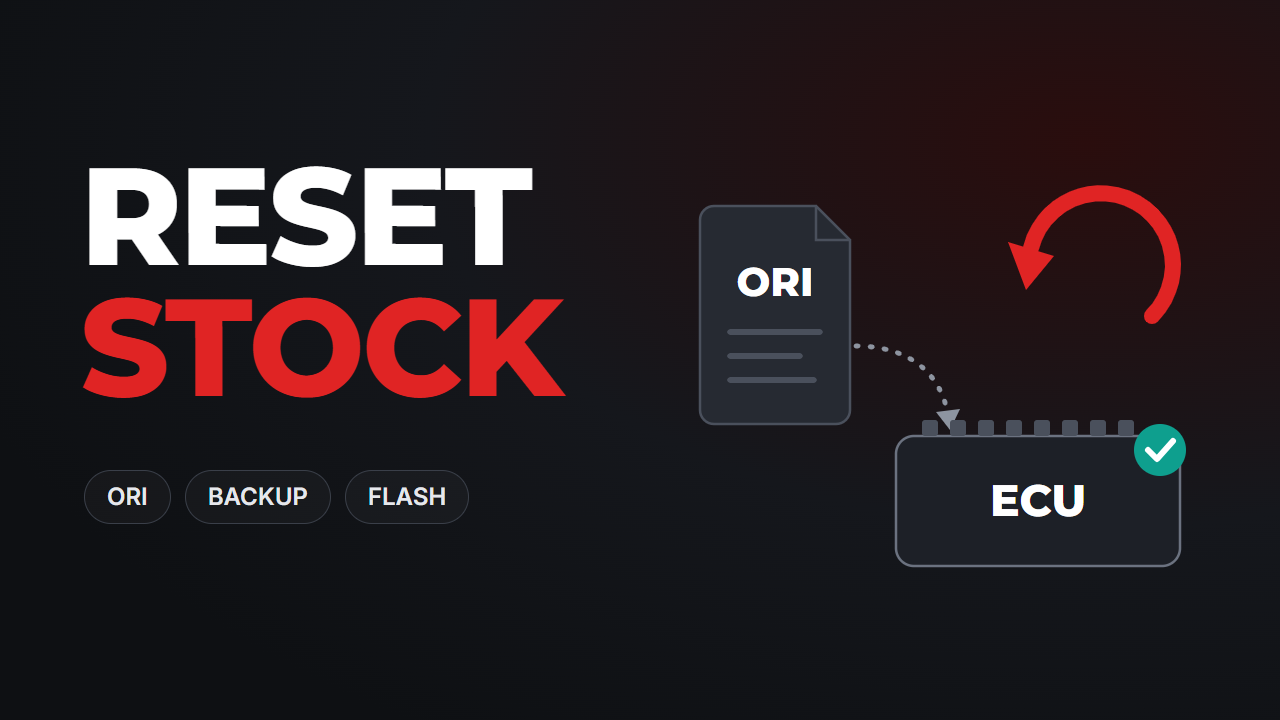
Reset to Stock puts the factory software back into the engine control unit. Tunes, system and fault deletes and other tuners' edits are gone, and the ECU runs on its factory calibration again. For tuners: send us the current file and get the factory file of the same version, ready to flash, on average within 30–60 minutes.
When cars go back to factory software
- Selling the car. The buyer asks for factory software, and a modified file shows up in a stock check.
- Dealer visits and warranty. Owners return to stock before a dealer visit or a warranty claim. The manufacturer may also update the software during a service, in which case the ECU ends up with a newer factory version.
- Software checks at inspection. In California, a car that fails Smog Check with "Modified Software" can only be retested after its software is restored to the manufacturer's version or a CARB-approved one.
- A bad or unknown tune. Flat spots, fault codes, nobody knows what was written. It is easier to go back to stock and build the solution again from the original.
- Before a new tune. Even if the previous software worked, the new one is better built from the original. Viezu gives its dealers the same advice: on a previously tuned car, return to stock first, then write the new map.
- Hardware back in place. A new particulate filter, catalyst or EGR valve has been fitted, and the ECU has to control and monitor it again.
Where the factory file comes from
A random "stock file for this engine" will not do. You need the original for that exact hardware and software version, and the three possible sources are not equally good.
- A backup of this ECU taken before the first write. This is the best option, because it is exactly what was on the car. A full bench backup covers all memory areas, and Autotuner names returning a vehicle to its original state as one of its two purposes. If another tuner took the backup, make sure first that it really is the original: a file named ori is often already modified.
- An original from a database, matched by hardware and software number. Without a backup, the factory file of the same version is looked up in a database, for example in the stock file section.
- A factory update. A newer version from the manufacturer is stock as well. Autotuner's FRF selection window for VAG works this way: flashing the original returns the vehicle to its original state, and earlier edits (tuning, patches, unlock) are erased.
A file from a different ECU, or a generic "stock" map from a tuning app, will not do. Forum threads describe cases where such a "stock" file failed California's inspection because the CAL ID and CVN did not match what was expected for that car.
Which software version to restore
Usually the one that was installed before the tune. There are a few forks in the road, though:
- The manufacturer has released an update. A newer factory version for the same hardware is stock too. If the customer is heading to the dealer anyway, the ECU may get updated during the service.
- The car has had a recall update. The file read before the tune may be older than the recall software. Autotuner warns about exactly this: after a Dieselgate update, the list may show a previously installed file. Agree with the owner which version goes back in.
- No original exists anywhere. No backup and no reference of the same version: the remaining route is a factory update, for example at a dealer.
ECUs that were unlocked for tuning need a separate thought. Writing the factory file can lock them again, and the next tune will then need another unlock, sometimes on the bench. EcuTek even splits this into two functions: Return to Stock leaves the ECU unlocked, while Reset to Factory State relocks it and removes the EcuTek data.
What comes back and what stays
| Item | After the return to stock |
|---|---|
| Power maps, speed and rev limiters | factory |
| DPF, EGR, AdBlue, lambda sensors, catalyst | active and monitored again |
| Faults that had been disabled | diagnosed again |
| Immobiliser, if it had been disabled | active again |
| CAL ID and CVN | factory values for this software version |
| Vehicle data in EEPROM: VIN, immobiliser, adaptations | unchanged if only the flash is written |
| Programming counter | one more entry: a return to stock does not erase the flash history |
A return to stock means writing the complete factory file rather than undoing individual edits. Another tuner's changes can sit in the maps, in the fault table and in the code, and it is easy to miss one by hand. The complete original also brings back the factory checksums and CVN.
The last row of the table matters to owners. After the return the ECU content is factory, but on many ECUs the fact that it was reflashed stays in the programming history. On VAG, for example, a scan tool shows the number of programming attempts, and GM controllers kept a reprogramming history back in the 2000s. Nobody can honestly promise that "the dealer won't see a thing".
One more thing: the return covers the ECU whose file you sent. If the gearbox (TCU) or a separate SCR unit (DCU) was modified too, each of them goes back to stock separately.
The hardware has to be in place
Factory software expects the factory set of components. The tune had switched off the checks on those parts, and after the return they run again: if something has been removed, a fault appears as soon as the ECU gets to checking that part.
The return goes smoothly
- All components are fitted and working: DPF, catalyst, EGR, AdBlue, sensors.
- The engine hardware is standard.
- The original matches the hardware and software version.
Expect fault codes
- The particulate filter has been cut out: the ECU sees a differential pressure that is too low (
P244A) or poor filter efficiency (P2002). - The AdBlue system is removed or the tank is empty: the no-start countdown runs again, just as before the AdBlue delete.
- The EGR valve is blanked or the catalyst removed: faults for those systems.
- The immobiliser was disabled after an ECU swap: the engine will not start until the ECU is matched to the car (see Immo Off).
- Upgraded hardware (turbo, injectors, intake, exhaust): EcuTek warns that on stock software the car may not start or may not run safely.
If components are already gone and the car needs stock software, put the hardware back first. Otherwise the customer gets fault codes instead of factory software, and on some cars reduced power as well.
What to do before and after flashing
- Read the ECU again before writing and confirm the software version. The manufacturer may have updated it without the owner knowing, and writing a file of the wrong version can leave the ECU unable to talk over OBD, the car unable to start and the recovery in the manufacturer's hands.
- Connect a power supply or battery charger. Writing stock software is a reflash like any other, and a sagging battery can interrupt it.
- Clear faults in all modules, including the ones outside the engine.
- Check the restored systems in live data: DPF regeneration, EGR operation, AdBlue.
- Let the car drive before an inspection. OBD readiness status counts from the moment faults were cleared, and incomplete monitors are a reason to fail, for example at California's Smog Check.
Take a full backup of every ECU before the first write and store it with the car's VIN. With that backup, a return to stock takes minutes and does not depend on whether a reference file can be found.
How to order a return to stock
- Read the ECU with the tool you use. If a pre-tune backup exists, attach it too.
- Upload the file to the portal and select RESET TO STOCK.
- Get the factory file, ready to flash, on average within 30–60 minutes.
- Flash the file, clear faults in all modules and check that the hardware works.
Need to put a car back on factory software? Upload the current file to the portal and select RESET TO STOCK, the factory file arrives on average within 30–60 minutes.
Order Reset to StockSupported ECUs for the RESET TO STOCK service
- Bosch EDC16C1
- Bosch EDC17CP02
- Bosch EDC17CP45
- Bosch MD1CP002
- Bosch MD1CP032
- Bosch MEVD17.2.6
- Bosch MEVD17.2.8
- Bosch MEVD17.2.G
- Bosch MG1CS003
- Bosch MG1CS024
- Bosch MG1CS049
- Bosch MG1CS201
- Siemens/Continental MSD80
- Siemens/Continental MSD81
- Siemens/Continental MSD85
- Temic DKG436 gen1
- ZF 8HPxx
- ZF 8HPxx-Gen3
- Bosch DQ38x
- Bosch DQ500 (MQB)
- Bosch EDC15P+
- Bosch EDC15VM+
- Bosch EDC16C4
- Bosch EDC16CP34
- Bosch EDC16U1
- Bosch EDC16U31
- Bosch EDC16U34
- Bosch EDC17C46
- Bosch EDC17C54
- Bosch EDC17C64
- Bosch EDC17C74
- Bosch EDC17CP04
- Bosch EDC17CP14
- Bosch EDC17CP20
- Bosch EDC17CP24
- Bosch EDC17CP44
- Bosch EDC17CP54
- Bosch EDC17CP74
- Bosch MD1
- Bosch MD1CP004
- Bosch MD1CP014
- Bosch MD1CS004
- Bosch MD1CS014
- Bosch ME17.1.6
- Bosch ME7.1
- Bosch ME7.1.1
- Bosch ME7.1.5
- Bosch ME7.5
- Bosch ME7.5.20
- Bosch ME7.5.5
- Bosch MED17.1
- Bosch MED17.1.1
- Bosch MED17.1.10
- Bosch MED17.1.21
- Bosch MED17.1.27
- Bosch MED17.1.6
- Bosch MED17.1.61
- Bosch MED17.1.62
- Bosch MED17.2.5
- Bosch MED17.5
- Bosch MED17.5.1
- Bosch MED17.5.2
- Bosch MED17.5.20
- Bosch MED17.5.21
- Bosch MED17.5.25
- Bosch MED17.5.5
- Bosch MED7.5.11
- Bosch MED9.1
- Bosch MED9.1.2
- Bosch MED9.1.5
- Bosch MED9.1.x
- Bosch MED9.5
- Bosch MED9.5.10
- Bosch MG1CS001
- Bosch MG1CS002
- Bosch MG1CS008
- Bosch MG1CS011
- Bosch MG1CS031
- Bosch MG1CS111
- Bosch MG1CS211
- Delphi DCM6.2V
- Siemens/Continental DL800
- Siemens/Continental DQ500
- Siemens/Continental PCR2.1
- Siemens/Continental PPD1.x
- Siemens/Continental SID603
- Siemens/Continental SIMOS 8.12
- Siemens/Continental Simos10.11
- Siemens/Continental Simos10.12
- Siemens/Continental Simos10.14
- Siemens/Continental Simos10.20
- Siemens/Continental Simos10.22
- Siemens/Continental Simos10.23
- Siemens/Continental Simos10.24
- Siemens/Continental Simos10.x
- Siemens/Continental Simos12
- Siemens/Continental Simos12.1
- Siemens/Continental Simos12.2
- Siemens/Continental Simos16.11
- Siemens/Continental Simos16.21
- Siemens/Continental Simos18.1
- Siemens/Continental Simos18.10
- Siemens/Continental Simos18.2
- Siemens/Continental Simos18.3
- Siemens/Continental Simos18.4
- Siemens/Continental Simos18.6
- Siemens/Continental Simos18.x
- Siemens/Continental Simos19.3
- Siemens/Continental Simos19.6
- Siemens/Continental Simos19.7
- Siemens/Continental Simos20.1.20
- Siemens/Continental Simos6.2
- Siemens/Continental Simos6.3
- Siemens/Continental Simos7.1
- Siemens/Continental Simos8.1
- Siemens/Continental Simos8.2
- Siemens/Continental Simos8.3
- Siemens/Continental Simos8.5
- Temic DL382
- Temic DL501
- Temic DQ200
- Temic DQ200 (MQB)
- Temic DQ200G2
- Temic DQ250 (MQB)
- Temic DQ250C
- Temic DQ250E
- Temic DQ250F
- Temic DQ400E
- ZF AL-552
- ZF AL552
- ZF ALx51
- Bosch BMS46
- Bosch DDE4.0
- Bosch EDC15
- Bosch EDC15C4
- Bosch EDC15M
- Bosch EDC16C1
- Bosch EDC16C35
- Bosch EDC16CP35
- Bosch EDC17C06
- Bosch EDC17C41
- Bosch EDC17C50
- Bosch EDC17C56
- Bosch EDC17C76
- Bosch EDC17CP02
- Bosch EDC17CP09
- Bosch EDC17CP45
- Bosch EDC17CP49
- Bosch MD1CP002
- Bosch MD1CP032
- Bosch MD1CS001
- Bosch ME17.2.1
- Bosch ME7.2
- Bosch ME9.2
- Bosch MED9.2.1
- Bosch MEV17.2.1
- Bosch MEV17.4.6
- Bosch MEVD17.2
- Bosch MEVD17.2.3
- Bosch MEVD17.2.4
- Bosch MEVD17.2.5
- Bosch MEVD17.2.6
- Bosch MEVD17.2.8
- Bosch MEVD17.2.9
- Bosch MEVD17.2.G
- Bosch MEVD17.2.H
- Bosch MEVD17.2.R
- Bosch MEVD17.2.X
- Bosch MG1CS001
- Bosch MG1CS003
- Bosch MG1CS024
- Bosch MG1CS049
- Bosch MG1CS201
- Siemens/Continental MDS81
- Siemens/Continental MS41
- Siemens/Continental MS42
- Siemens/Continental MS43
- Siemens/Continental MS45
- Siemens/Continental MSD46
- Siemens/Continental MSD80
- Siemens/Continental MSD81
- Siemens/Continental MSD85
- Siemens/Continental MSD87
- Siemens/Continental MSS45
- Siemens/Continental MSS52
- Siemens/Continental MSS54
- Siemens/Continental MSS54HP
- Siemens/Continental MSS60
- Siemens/Continental MSS65
- Siemens/Continental MSV70
- Siemens/Continental MSV80
- Siemens/Continental MSV90
- Temic DKG436 gen1
- Temic DKG436 gen2
- ZF 8HP75H
- ZF 8HPxx
- ZF 8HPxx-Gen3
- Bosch EDC16+
- Bosch EDC16C37
- Bosch EDC16C39
- Bosch EDC17C19
- Bosch EDC17C59
- Bosch EDC17CP47
- Bosch ME7.6.4
- Bosch ME9.6.1
- Delco E37
- Delco E38
- Delco E39
- Delco E39A
- Delco E41
- Delco E46
- Delco E67
- Delco E78
- Delco E80
- Delco E82
- Delco E83
- Delco E84
- Delco E87
- Delco E92
- Delco E98
- Delphi DCM3.7AP
- Siemens/Continental D42
- Siemens/Continental D52
- Siemens/Continental SIM2K-160
- Siemens/Continental SIMTEC 76
- Bosch EDC15C2
- Bosch EDC15C7
- Bosch EDC16C0
- Bosch EDC16C08
- Bosch EDC16C34
- Bosch EDC16C39
- Bosch EDC16CP39
- Bosch EDC17C10
- Bosch EDC17C60
- Bosch EDC17CP11
- Bosch EDC17CP42
- Bosch EDC17CP52
- Bosch MD1CS003
- Bosch ME17.9.52
- Bosch ME17.9.53
- Bosch ME7.4.4
- Bosch ME7.4.5
- Bosch ME7.4.7
- Bosch MED17.4
- Bosch MED17.4.2
- Bosch MED17.4.4
- Bosch MEV17.4
- Bosch MEV17.4.2
- Bosch MEVD17.4.2
- Bosch MEVD17.4.4
- Bosch MG1CS032
- Bosch MG1CS042
- Bosch MG1CS069
- Delphi DCM3.4(+)
- Delphi DCM3.5
- Delphi DCM6.2A
- Delphi DCM6.2C
- Delphi DCM7.1A
- Delphi DCM7.1B
- Marelli MJD8
- Marelli MJD8F2
- Marelli MJD8F3
- Marelli MJD9
- Marelli MJD9DF
- Siemens/Continental SID201
- Siemens/Continental SID208
- Siemens/Continental SID801
- Siemens/Continental SID803
- Siemens/Continental SID803A
- Siemens/Continental SID804
- Siemens/Continental SID806
- Siemens/Continental SID807
- Siemens/Continental SID807EVO
- Siemens/Continental V56.12
- Siemens/Continental VD56.1
- Valeo J34P
- Valeo JP34
- Valeo V46.11
- Valeo V46.12
- Valeo V46.13
- Valeo VD46.1
- Valeo VD56.1
- Visteon DCU-102
- Bosch DQ38x
- Bosch DQ500 (MQB)
- Bosch EDC17C46
- Bosch EDC17C64
- Bosch EDC17C74
- Bosch MD1CS004
- Bosch MG1CS011
- Siemens/Continental Simos12.1
- Siemens/Continental Simos12.2
- Siemens/Continental Simos18.1
- Siemens/Continental Simos18.10
- Siemens/Continental Simos18.2
- Siemens/Continental Simos18.3
- Siemens/Continental Simos18.6
- Siemens/Continental Simos19.3
- Siemens/Continental Simos19.6
- Temic DL382
- Temic DQ200 (MQB)
- Temic DQ200G2
- Temic DQ250 (MQB)
- Bosch EDC16C08
- Bosch EDC16C34
- Bosch EDC17C10
- Bosch EDC17C60
- Bosch MD1CS003
- Bosch MED17.4
- Bosch MED17.4.2
- Bosch MED17.4.4
- Bosch MEV17.4
- Bosch MEV17.4.2
- Bosch MEVD17.4.2
- Bosch MEVD17.4.4
- Bosch MG1CS032
- Bosch MG1CS042
- Delphi DCM3.4(+)
- Delphi DCM3.5
- Delphi DCM6.2A
- Delphi DCM6.2C
- Delphi DCM7.1A
- Siemens/Continental SID806
- Siemens/Continental SID807
- Siemens/Continental SID807EVO
- Siemens/Continental VD56.1
- Valeo VD46.1
- Valeo VD56.1
- Bosch EDC17C42
- Bosch EDC17C84
- Bosch MD1CS006
- Bosch MD1CS016
- Bosch ME17.9.20
- Delphi DCM1.2
- Delphi DCM3.4
- Sagem S3000
- Siemens/Continental EMS3110
- Siemens/Continental EMS3125
- Siemens/Continental EMS3132
- Siemens/Continental EMS3140
- Siemens/Continental EMS3141
- Siemens/Continental EMS3150
- Siemens/Continental EMS3155
- Siemens/Continental EMS3160
- Siemens/Continental EMS3161
- Siemens/Continental EMS3180
- Siemens/Continental EMS3181
- Siemens/Continental SID301
- Siemens/Continental SID303
- Siemens/Continental SID305
- Siemens/Continental SID305/6
- Siemens/Continental SID306
- Siemens/Continental SID307
- Siemens/Continental SID309
- Siemens/Continental SID310
- Siemens/Continental SIRIUS 32
- Valeo V40
- Valeo V42
- Valeo V50.1
- Bosch EDC15C2
- Bosch EDC15C7
- Bosch EDC16C08
- Bosch EDC16C34
- Bosch EDC16C39
- Bosch EDC16C39 (CAN)
- Bosch EDC16C39 (K-Line)
- Bosch EDC16C8
- Bosch EDC16CP39
- Bosch EDC17C10
- Bosch EDC17C49
- Bosch EDC17C69
- Bosch EDC17C79
- Bosch EDC17C84
- Bosch EDC17CP52
- Bosch MD1CS003
- Bosch MD1CS006
- Bosch ME17.3.0
- Bosch ME17.9.51
- Delphi DCM3.4(+)
- Delphi DCM3.5
- Delphi DCM7.1A
- Marelli MJD6
- Marelli MJD8
- Marelli MJD8F2
- Marelli MJD8F3
- Marelli MJD9DF
- Siemens/Continental SID803
- Siemens/Continental SID803A
- Visteon DCU-102
- ZF 9HP48
- ZF 9HP48-948TE
- Bosch EDC15P+
- Bosch EDC15VM+
- Bosch EDC16C3
- Bosch EDC16C34
- Bosch EDC16C7
- Bosch EDC16CP39
- Bosch EDC16U31
- Bosch EDC17C10
- Bosch EDC17C70
- Bosch EDC17CP42
- Bosch MD1CS004
- Bosch MD1CS005
- Bosch ME9.0C
- Bosch MG1CS011
- Delphi DCM3.5
- Delphi DCM6.1
- Delphi DCM7.1
- Marelli MFD6F3
- Marelli MJD8F2
- Siemens/Continental EMS
- Siemens/Continental EMS2102
- Siemens/Continental EMS24xx
- Siemens/Continental EMS2510
- Siemens/Continental EMS2511
- Siemens/Continental EMS25xx
- Siemens/Continental SID202
- Siemens/Continental SID206
- Siemens/Continental SID208
- Siemens/Continental SID209
- Siemens/Continental SID209 - FRV
- Siemens/Continental SID209recovery
- Siemens/Continental SID211
- Siemens/Continental SID802
- Siemens/Continental SID807EVO
- Temic DL382
- Temic DQ200G2
- Temic DQ250 (MQB)
- Visteon DCU-102
- Bosch EDC15C7
- Bosch EDC16+
- Bosch EDC16C39
- Bosch EDC16CP39
- Bosch EDC17C08
- Bosch EDC17C53
- Bosch EDC17C57
- Bosch EDC17CP14
- Bosch ME17.9.1
- Bosch ME17.9.11
- Bosch ME17.9.11.1
- Bosch ME17.9.21
- Bosch ME17.9.21.1
- Bosch MED17.9.8
- Delphi DCM3.7AP
- Delphi DCM6.2AP
- Kefico CPEGD2.20.1
- Kefico CPEGD2.20.2
- Kefico CPEGD2.20.3
- Kefico CPEGD2.20.4
- Kefico CPEGD2.20.x
- Kefico CPEGD3.20.1
- Kefico CPEGP3.20.1
- Kefico CPGPSH3.26.1
- Kefico MEG17.9.12
- Kefico MEG17.9.13
- Siemens/Continental SIM2K-140
- Siemens/Continental SIM2K-141
- Siemens/Continental SIM2K-142
- Siemens/Continental SIM2K-240
- Siemens/Continental SIM2K-240R
- Siemens/Continental SIM2K-241
- Siemens/Continental SIM2K-242
- Siemens/Continental SIM2K-245
- Siemens/Continental SIM2K-250
- Siemens/Continental SIM2K-251
- Siemens/Continental SIM2K-253
- Siemens/Continental SIM2K-259
- Siemens/Continental SIM2K-341
- Siemens/Continental SIMK-43
- Bosch EDC15C7
- Bosch EDC16+
- Bosch EDC16C39
- Bosch EDC16CP34
- Bosch EDC17C08
- Bosch EDC17C53
- Bosch EDC17C57
- Bosch EDC17CP14
- Bosch EDC17CP62
- Bosch MD1CS012
- Bosch ME17.9.1
- Bosch ME17.9.11
- Bosch ME17.9.11.1
- Bosch ME17.9.21
- Bosch ME17.9.21.1
- Bosch MED17.9.8
- Bosch MEG17.9.21
- Bosch MEG17.9.8
- Delphi DCM3.7AP
- Delphi DCM6.2AP
- Kefico CPEGD2.20.1
- Kefico CPEGD2.20.2
- Kefico CPEGD2.20.3
- Kefico CPEGD2.20.4
- Kefico CPEGD2.20.x
- Kefico CPEGD3.20.1
- Kefico CPEGP3.20.1
- Kefico CPGPSH3.26.1
- Kefico E6T348XX
- Kefico MEG17.9.12
- Kefico MEG17.9.13
- Siemens/Continental SIM2K-140
- Siemens/Continental SIM2K-141
- Siemens/Continental SIM2K-142
- Siemens/Continental SIM2K-240
- Siemens/Continental SIM2K-240R
- Siemens/Continental SIM2K-241
- Siemens/Continental SIM2K-242
- Siemens/Continental SIM2K-245
- Siemens/Continental SIM2K-250
- Siemens/Continental SIM2K-251
- Siemens/Continental SIM2K-253
- Siemens/Continental SIM2K-259
- Siemens/Continental SIM2K-260
- Siemens/Continental SIM2K-341
- Bosch EDC15C2
- Bosch EDC15C7
- Bosch EDC16C08
- Bosch EDC16C39 (CAN)
- Bosch EDC16C8
- Bosch EDC16CP31
- Bosch EDC16CP39
- Bosch EDC17C49
- Bosch EDC17C69
- Bosch EDC17C79
- Bosch EDC17CP27
- Bosch ME17.3.0
- Marelli MJD6
- Marelli MJD8
- Marelli MJD8F2
- Marelli MJD8F3
- Marelli MJD9DF
- Siemens/Continental SID803
- Siemens/Continental SID803A
- ZF 8HP45-845RE
- ZF 8HP50
- ZF 9HP48-948TE
- Bosch EDC15C0
- Bosch EDC15C6
- Bosch EDC15C6-5.70
- Bosch EDC16C2
- Bosch EDC16C32
- Bosch EDC16CP31
- Bosch EDC16CP36
- Bosch EDC17C42
- Bosch EDC17C43
- Bosch EDC17C66
- Bosch EDC17C84
- Bosch EDC17CP01
- Bosch EDC17CP10
- Bosch EDC17CP46
- Bosch EDC17CP57
- Bosch EDC17CP60
- Bosch EDC17CP66
- Bosch MD1CP001
- Bosch MD1CS006
- Bosch ME2.8
- Bosch ME2.8.1
- Bosch MED17.7.1
- Bosch MED17.7.2
- Bosch MED17.7.3
- Bosch MED17.7.3.1
- Bosch MED17.7.5
- Bosch MED17.7.7
- Bosch MG1CS002
- Bosch VGS2-FDCT gen1
- Bosch VGS2-FDCT gen2
- Bosch VGS3-FDCT (8G Tronic)
- Delphi CRD.11
- Delphi CRD2
- Delphi CRD3
- Delphi CRD3.10
- Delphi CRD3.1R
- Delphi CRD3.20
- Delphi CRD3.2R
- Delphi CRD3.30
- Delphi CRD3.40
- Delphi CRD3.50
- Delphi CRD3.58
- Delphi CRD3.59
- Delphi CRD3.60
- Delphi CRD3.7A
- Delphi CRD3.E1
- Delphi CRD3.F1
- Delphi CRD3.N5
- Delphi CRD3P.A0
- Delphi CRD3P.B0
- Delphi CRD3P.C0
- Delphi CRD3P.D1
- Delphi CRD3P.E1
- Delphi CRD3P.G0
- Siemens/Continental SID307
- Siemens/Continental SID310
- Siemens/Continental VGS4-NAG2
- Siemens/Continental VGSx-NAG2
- Bosch EDC15C3
- Bosch EDC16C3
- Bosch EDC16C36
- Bosch EDC16C41
- Bosch EDC16CP33
- Bosch EDC16CP42
- Bosch EDC17C11
- Bosch EDC17C42
- Bosch EDC17C45
- Bosch EDC17C84
- Bosch MD1CS006
- Bosch MD1CS016
- Bosch ME17.9.20
- Bosch ME17.9.5
- Bosch ME17.9.51
- Bosch ME17.9.64
- Delphi DCM1.2
- Delphi DCM3.4
- Delphi DDCR
- Denso DIESEL SH705x NIS
- Siemens/Continental EMS3125
- Siemens/Continental EMS3140
- Siemens/Continental EMS3141
- Siemens/Continental EMS3150
- Siemens/Continental EMS3155
- Siemens/Continental EMS3160
- Siemens/Continental EMS3161
- Siemens/Continental SID301
- Siemens/Continental SID303
- Siemens/Continental SID304
- Siemens/Continental SID305
- Siemens/Continental SID305/6
- Siemens/Continental SID306
- Siemens/Continental SID307
- Siemens/Continental SID309
- Siemens/Continental SID310
- Siemens/Continental SID321
- Siemens/Continental SID809
- Valeo V50.1
- Bosch EDC15C2
- Bosch EDC15C3
- Bosch EDC15M
- Bosch EDC16C3
- Bosch EDC16C36
- Bosch EDC16C39
- Bosch EDC16C9
- Bosch EDC16CP33
- Bosch EDC17C10
- Bosch EDC17C11
- Bosch EDC17C18
- Bosch EDC17C19
- Bosch EDC17C42
- Bosch EDC17C59
- Bosch EDC17C60
- Bosch EDC17C69
- Bosch EDC17C84
- Bosch EDC17CP47
- Bosch MD1CS003
- Bosch ME1.5.5
- Bosch ME17.3.0
- Bosch ME17.9.6
- Bosch ME7
- Bosch ME7.6.2
- Bosch ME7.6.3
- Bosch ME7.6.4
- Bosch ME7.6H4
- Bosch ME9
- Bosch ME9.6.1
- Bosch MG1CA811
- Bosch MG1CS032
- Bosch MG1CS042
- Delco E39
- Delco E39A
- Delco E78
- Delco E80
- Delco E83
- Delco E84
- Delco E87
- Delco E98
- Delphi DCM3.7AP
- Delphi DCM6.2A
- Delphi DCM7.1A
- Delphi DCM7.1B
- Denso DIESEL SH705x OP
- Marelli MJD6
- Marelli MJD8F3
- Marelli MJD9DF
- Siemens/Continental SID309
- Siemens/Continental SID310
- Siemens/Continental SID321
- Siemens/Continental SID809
- Siemens/Continental SIMTEC 70
- Siemens/Continental SIMTEC 75
- Siemens/Continental SIMTEC 81
- Siemens/Continental V56.12
- Siemens/Continental VD56.1
- Valeo VD46.1
- Valeo VD56.1
- ZF 9HP48
- Bosch EDC15C2
- Bosch EDC15C7
- Bosch EDC16C08
- Bosch EDC16C34
- Bosch EDC16CP39
- Bosch EDC17C10
- Bosch EDC17C60
- Bosch EDC17CP11
- Bosch EDC17CP42
- Bosch EDC17CP52
- Bosch MD1CS003
- Bosch ME17.9.52
- Bosch ME17.9.53
- Bosch ME7.4.4
- Bosch ME7.4.5
- Bosch ME7.4.7
- Bosch MED17.4
- Bosch MED17.4.2
- Bosch MED17.4.4
- Bosch MEV17.4
- Bosch MEV17.4.2
- Bosch MEVD17.4.2
- Bosch MEVD17.4.4
- Bosch MG1CS032
- Bosch MG1CS042
- Bosch MG1CS069
- Delphi DCM3.4(+)
- Delphi DCM3.5
- Delphi DCM6.2A
- Delphi DCM6.2C
- Delphi DCM7.1A
- Delphi DCM7.1B
- Marelli MJD8
- Marelli MJD8F2
- Marelli MJD8F3
- Marelli MJD9DF
- Siemens/Continental SID201
- Siemens/Continental SID208
- Siemens/Continental SID801
- Siemens/Continental SID803
- Siemens/Continental SID803A
- Siemens/Continental SID804
- Siemens/Continental SID806
- Siemens/Continental SID807
- Siemens/Continental SID807EVO
- Siemens/Continental V56.12
- Siemens/Continental VD56.1
- Valeo J34P
- Valeo JP34
- Valeo V46.11
- Valeo V46.12
- Valeo V46.13
- Valeo VD46.1
- Valeo VD56.1
- Visteon DCU-102
- Bosch EDC17CP04
- Bosch EDC17CP14
- Bosch EDC17CP24
- Bosch EDC17CP44
- Bosch EDC17CP54
- Bosch ME7.1.1
- Bosch MG1CS008
- Siemens/Continental Simos18.1
- Siemens/Continental Simos18.10
- Siemens/Continental Simos18.2
- Siemens/Continental Simos18.3
- Siemens/Continental Simos18.4
- Siemens/Continental Simos18.6
- Temic DL382
- Temic DL501
- Temic DQ250 (MQB)
- ZF AL552
- ZF ALx51
- Bosch EDC15C3
- Bosch EDC16C3
- Bosch EDC16C36
- Bosch EDC16C41
- Bosch EDC16CP33
- Bosch EDC17C11
- Bosch EDC17C42
- Bosch EDC17C45
- Bosch EDC17C84
- Bosch MD1CS006
- Bosch MD1CS016
- Bosch ME17.9.20
- Bosch ME7.6.3
- Delphi DCM1.2
- Delphi DCM3.4
- Delphi DDCR
- Denso DIESEL SH705x NIS
- Siemens/Continental EMS3125
- Siemens/Continental EMS3140
- Siemens/Continental EMS3141
- Siemens/Continental EMS3150
- Siemens/Continental EMS3155
- Siemens/Continental EMS3160
- Siemens/Continental EMS3161
- Siemens/Continental SID301
- Siemens/Continental SID303
- Siemens/Continental SID305
- Siemens/Continental SID305/6
- Siemens/Continental SID306
- Siemens/Continental SID307
- Siemens/Continental SID309
- Siemens/Continental SID310
- Siemens/Continental SID321
- Siemens/Continental SID809
- Siemens/Continental SIRIUS 32
- Valeo V40
- Valeo V42
- Valeo V50.1
- Bosch DQ38x
- Bosch DQ500 (MQB)
- Bosch EDC15
- Bosch EDC15P+
- Bosch EDC15VM+
- Bosch EDC16U1
- Bosch EDC16U31
- Bosch EDC16U34
- Bosch EDC17C46
- Bosch EDC17C54
- Bosch EDC17C64
- Bosch EDC17C74
- Bosch EDC17CP14
- Bosch EDC17CP20
- Bosch EDC17CP74
- Bosch MD1CS004
- Bosch ME7.5
- Bosch ME7.5.20
- Bosch MED17.1
- Bosch MED17.1.21
- Bosch MED17.1.27
- Bosch MED17.1.61
- Bosch MED17.2.5
- Bosch MED17.5
- Bosch MED17.5.1
- Bosch MED17.5.2
- Bosch MED17.5.20
- Bosch MED17.5.21
- Bosch MED17.5.25
- Bosch MED17.5.5
- Bosch MED9.1
- Bosch MED9.1.x
- Bosch MED9.5
- Bosch MED9.5.10
- Bosch MG1CS001
- Bosch MG1CS011
- Bosch MG1CS111
- Delphi DCM6.2V
- Siemens/Continental PCR2.1
- Siemens/Continental PPD1.x
- Siemens/Continental Simos10.11
- Siemens/Continental Simos10.12
- Siemens/Continental Simos10.14
- Siemens/Continental Simos10.20
- Siemens/Continental Simos10.22
- Siemens/Continental Simos10.23
- Siemens/Continental Simos10.24
- Siemens/Continental Simos10.x
- Siemens/Continental Simos12.1
- Siemens/Continental Simos12.2
- Siemens/Continental Simos18.1
- Siemens/Continental Simos18.10
- Siemens/Continental Simos18.2
- Siemens/Continental Simos18.3
- Siemens/Continental Simos18.6
- Siemens/Continental Simos19.3
- Siemens/Continental Simos20.1.20
- Siemens/Continental Simos7.1
- Temic DL382
- Temic DL501
- Temic DQ200
- Temic DQ200 (MQB)
- Temic DQ200G2
- Temic DQ250 (MQB)
- Temic DQ250C
- Temic DQ250E
- Temic DQ250F
- ZF ALx51
- Bosch DQ38x
- Bosch DQ500 (MQB)
- Bosch EDC15P+
- Bosch EDC15VM+
- Bosch EDC16U1
- Bosch EDC16U31
- Bosch EDC16U34
- Bosch EDC17C46
- Bosch EDC17C54
- Bosch EDC17C64
- Bosch EDC17C74
- Bosch EDC17CP14
- Bosch EDC17CP20
- Bosch EDC17CP74
- Bosch MD1CS004
- Bosch ME7.5
- Bosch ME7.5.20
- Bosch MED17.1.21
- Bosch MED17.1.27
- Bosch MED17.1.61
- Bosch MED17.2.5
- Bosch MED17.5
- Bosch MED17.5.1
- Bosch MED17.5.2
- Bosch MED17.5.20
- Bosch MED17.5.21
- Bosch MED17.5.25
- Bosch MED17.5.5
- Bosch MED7.5.11
- Bosch MED9.1
- Bosch MED9.1.x
- Bosch MED9.5
- Bosch MED9.5.10
- Bosch MG1CS001
- Bosch MG1CS011
- Bosch MG1CS111
- Delphi DCM6.2V
- Siemens/Continental PCR2.1
- Siemens/Continental PPD1.x
- Siemens/Continental Simos10.11
- Siemens/Continental Simos10.12
- Siemens/Continental Simos10.14
- Siemens/Continental Simos10.20
- Siemens/Continental Simos10.22
- Siemens/Continental Simos10.23
- Siemens/Continental Simos10.24
- Siemens/Continental Simos10.x
- Siemens/Continental Simos12
- Siemens/Continental Simos12.1
- Siemens/Continental Simos12.2
- Siemens/Continental Simos18.1
- Siemens/Continental Simos18.2
- Siemens/Continental Simos18.3
- Siemens/Continental Simos18.6
- Siemens/Continental Simos19.3
- Siemens/Continental Simos20.1.20
- Siemens/Continental Simos7.1
- Temic DL382
- Temic DL501
- Temic DQ200
- Temic DQ200 (MQB)
- Temic DQ200G2
- Temic DQ250 (MQB)
- Temic DQ250C
- Temic DQ250E
- Temic DQ250F
- Bosch DQ38x
- Bosch DQ500 (MQB)
- Bosch EDC15
- Bosch EDC15P+
- Bosch EDC15VM+
- Bosch EDC16CP34
- Bosch EDC16U1
- Bosch EDC16U31
- Bosch EDC16U34
- Bosch EDC17C46
- Bosch EDC17C54
- Bosch EDC17C64
- Bosch EDC17C74
- Bosch EDC17CP04
- Bosch EDC17CP14
- Bosch EDC17CP20
- Bosch EDC17CP24
- Bosch EDC17CP44
- Bosch EDC17CP74
- Bosch MD1CP004
- Bosch MD1CS004
- Bosch ME7.1
- Bosch ME7.1.1
- Bosch ME7.5
- Bosch ME7.5.10
- Bosch ME7.5.20
- Bosch MED17.1
- Bosch MED17.1.21
- Bosch MED17.1.27
- Bosch MED17.1.6
- Bosch MED17.1.61
- Bosch MED17.2.5
- Bosch MED17.5
- Bosch MED17.5.1
- Bosch MED17.5.2
- Bosch MED17.5.20
- Bosch MED17.5.21
- Bosch MED17.5.25
- Bosch MED17.5.5
- Bosch MED7.5.11
- Bosch MED9.1
- Bosch MED9.1.5
- Bosch MED9.1.x
- Bosch MED9.5
- Bosch MED9.5.10
- Bosch MG1CS001
- Bosch MG1CS002
- Bosch MG1CS011
- Bosch MG1CS111
- Delphi DCM6.2V
- Siemens/Continental DQ500
- Siemens/Continental PCR2.1
- Siemens/Continental PPD1.x
- Siemens/Continental SID603
- Siemens/Continental Simos10.11
- Siemens/Continental Simos10.12
- Siemens/Continental Simos10.14
- Siemens/Continental Simos10.20
- Siemens/Continental Simos10.22
- Siemens/Continental Simos10.23
- Siemens/Continental Simos10.24
- Siemens/Continental Simos10.x
- Siemens/Continental Simos12.1
- Siemens/Continental Simos12.2
- Siemens/Continental Simos16.11
- Siemens/Continental Simos16.21
- Siemens/Continental Simos18.1
- Siemens/Continental Simos18.10
- Siemens/Continental Simos18.2
- Siemens/Continental Simos18.3
- Siemens/Continental Simos18.4
- Siemens/Continental Simos18.6
- Siemens/Continental Simos18.x
- Siemens/Continental Simos19.3
- Siemens/Continental Simos20.1.20
- Siemens/Continental Simos7.1
- Siemens/Continental Simos8.3
- Siemens/Continental Simos8.5
- Temic DL382
- Temic DL501
- Temic DQ200
- Temic DQ200 (MQB)
- Temic DQ200G2
- Temic DQ250 (MQB)
- Temic DQ250C
- Temic DQ250E
- Temic DQ250F
- ZF AL552
- ZF ALx51
- Bosch EDC15C11
- Bosch EDC15C3
- Bosch EDC16C31
- Bosch EDC16C34
- Bosch EDC16C35
- Bosch EDC17CP22
- Bosch EDC17CP48
- Bosch EDC17CP68
- Bosch ME7.0
- Bosch ME7.5
- Bosch ME9.0
- Bosch ME9.0C
- Bosch MED17.1
- Bosch MED17.2
- Bosch MG1CS080
- Delphi DCM3.5
- Siemens/Continental SID206
- Siemens/Continental SID208
- Siemens/Continental SID803
- Siemens/Continental SID803A
- Siemens/Continental SID807
- Siemens/Continental SID807EVO
Frequently asked questions
Will the car be back in a fully factory state?
The program and calibration will, as long as the original of the same version is flashed. If parts such as the DPF or EGR were removed, their faults will appear, and a return to stock does not erase the flash history.
Will the dealer know the ECU was flashed?
The ECU content will be factory, but many ECUs keep a programming counter and history. Nobody can guarantee that no traces remain.
The original file was not saved. What now?
A factory file of the same hardware and software version from a database, or an official update from the manufacturer, will do. Send the current file: the version is identified from it.
Can I flash a stock file from another car?
Only if the hardware and software version match. A file from a different ECU or a generic stock map from an app may not work and will not match the CAL ID and CVN.
What happens if the particulate filter has already been cut out?
The ECU will notice the missing filter: differential pressure too low (P244A) or poor efficiency (P2002). Refit the filter before returning to stock.
Will the VIN, immobiliser data and adaptations be kept?
As a rule, yes: this data lives in EEPROM or DFLASH and is not changed when only the flash memory is written.
What should I do after flashing stock software?
Clear faults in all modules, check DPF, EGR and AdBlue operation, and let the car drive before an inspection so the OBD readiness monitors complete.
How long does the file take?
On average 30–60 minutes.