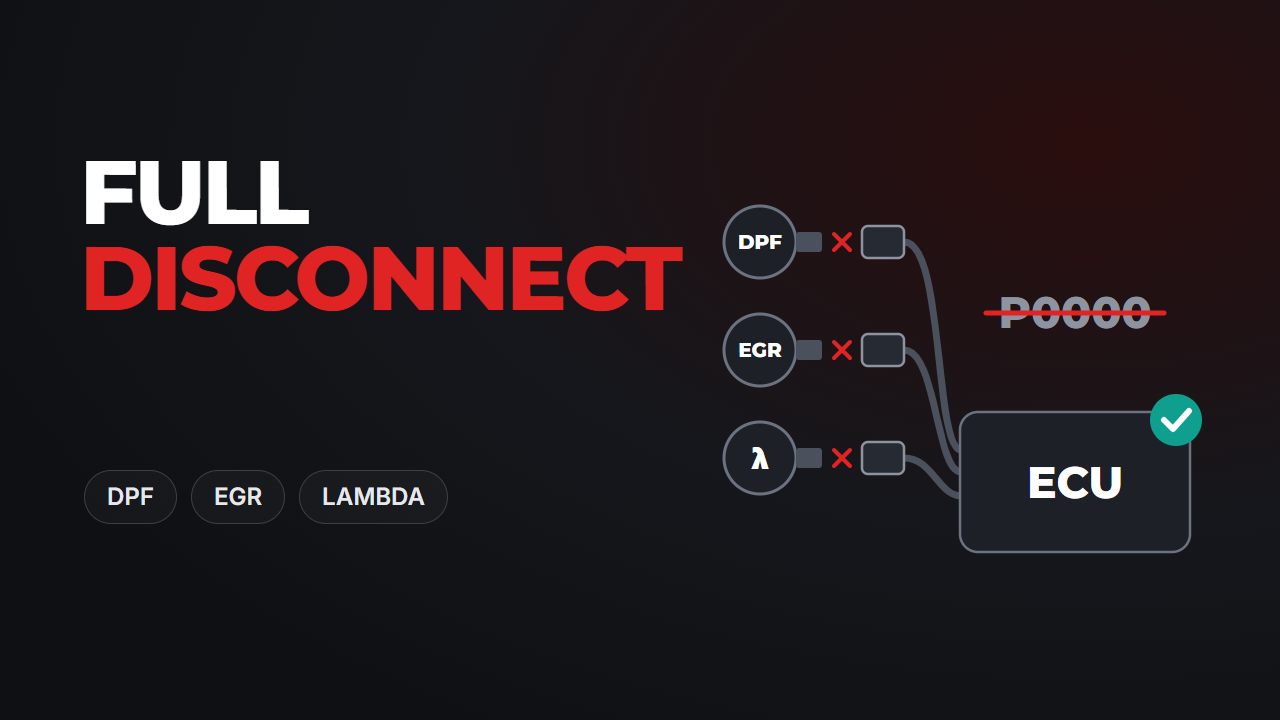
Solutions Full Disconnect are complete solutions for Denso ECUs, most often on Toyota. Once the file is written, the connectors of the DPF, EGR and lambda control sensors can be unplugged: the ECU sets no faults, including a blank P0000, and the automatic gearbox does not drop into limp mode. For tuners: a file with corrected checksums, on average within 30–60 minutes.
How a full disconnect differs from a regular delete
A regular DPF Off or EGR Off switches the system and its faults off, but the sensors stay fitted and connected, and the ECU keeps reading their signals. Unplug a connector after such a delete and a fault comes back, this time for the sensor circuit rather than the system.
Full Disconnect is meant for a different situation: the components are removed or faulty, and the sensors have to be disconnected for good. So the file switches off the function and every check tied to those sensors as well.
Why an unplugged connector sets a fault
The ECU checks a sensor in several layers. The first is the electrical circuit: open circuit, short, signal outside the permitted range. The second is plausibility: does the signal agree with what the ECU expects from other sensors. The third is how the system itself performs, for example filter efficiency. A regular delete removes the third layer, while the first two keep running.
To the ECU, an unplugged connector is an open circuit. For the DPF differential pressure sensor, SAE J2012 defines this group as P2452–P2455: circuit fault, range/performance, signal low or high. Exhaust temperature sensors, the EGR valve and the lambda sensor have circuit codes of their own, and those are checked whether or not the system itself is switched off.
Where a blank P0000 comes from
An OBD fault code is sent as two bytes: the first two bits give the letter (P, C, B or U) and the rest give the number. Two zero bytes are read by a scan tool as P0000, a fault with no number.
This happens when a fault was "switched off" in the software by zeroing its entry in the fault table while the check itself keeps running. The ECU still detects the problem and may light the lamp, but it can no longer name it. In a full solution those checks are switched off entirely, so there is no blank P0000 either.
What the automatic gearbox has to do with it
A modern car carries dozens of control units, and the engine ECU talks to the gearbox controller over the CAN bus. An engine fault is visible beyond the engine ECU: on cars with an automatic it can affect the gearbox too, up to and including limp mode. The full solution takes care of this as well: after flashing, the automatic works as normal.
If the gearbox already went into limp mode after someone else's partial solution, check the faults in both controllers: engine and gearbox.
Which ECUs it covers
In our catalogue the solution exists for Denso diesel ECUs from Gen 1 to Gen 4 and petrol ECUs of Gen 3 and Gen 4. The generations differ in software size, from 368 KB on Gen 1 up to 8 MB on Gen 4. Many tools cannot read Gen 1 and Gen 2 units over OBD; in that case the original for the solution comes from a Request VR File order.
If you only remove one system and its sensors stay connected, a regular delete of that system is enough.
What to do with the hardware
- Insulate and secure any unplugged connectors left in the wiring loom so they do not chafe or short to ground.
- Plug the holes left in the exhaust by removed sensors.
- On the 2.2 D-CAT (2AD-FHV), the exhaust treatment also includes fuel injection into the exhaust port. If that was touched too, mention it in the order.
- After flashing, clear faults in all modules, including the gearbox controller, and check after a test drive that nothing new has appeared.
How to order
- Read the ECU with the tool you use, or request a VR file if it cannot be read over OBD.
- Upload the file to the portal and select SOLUTIONS FULL DISCONECT. In the order, list the sensors you are removing and the gearbox type.
- Get the finished file with corrected checksums, on average within 30–60 minutes.
- Flash the file, unplug the connectors and clear faults in all modules.
Disabling the DPF, EGR and lambda control systems increases emissions and changes the vehicle's emissions class. In the EU, the UK, the US and a number of other countries this is prohibited on public roads and may cause an inspection failure. The service is intended for tuners and is used where the law allows it: motorsport, off-road, export, vehicles not used on public roads. Responsibility for using the file lies with the vehicle owner.
Need to unplug the DPF, EGR and lambda sensors without faults? Upload the file to the portal and select SOLUTIONS FULL DISCONECT, the finished file arrives on average within 30–60 minutes.
Order Full DisconnectSupported ECUs for the SOLUTIONS FULL DISCONECT service
Frequently asked questions
How is Full Disconnect different from DPF Off or EGR Off?
A regular delete switches the system off, but its sensors have to stay connected. After Full Disconnect the connectors can be unplugged, because the checks on those sensors are switched off in the file as well.
Why does a scan tool show P0000 after a DPF delete?
This happens when the fault entry was zeroed in the software while the check keeps running: the ECU detects the problem, but the fault no longer has a number. A full solution switches the check itself off.
Why did the gearbox go into limp mode after a delete?
The engine ECU is connected to the gearbox over the CAN bus, and an engine fault can affect the automatic. The full solution is built so that the gearbox works normally.
Which connectors can be unplugged?
The sensor connectors of the DPF, EGR and lambda control systems. List in the order exactly what you are removing and the gearbox type.
What if the Denso ECU cannot be read over OBD?
For Gen 1 and Gen 2 the original can be obtained with Request VR File, and the solution built on it.
Can the car be returned to stock later?
Yes, as long as the original file is saved and the sensors and components are refitted and working.
Is a full disconnect legal?
Not on public roads in the EU, the UK, the US and many other countries. The service is intended for motorsport, off-road, export and vehicles not used on public roads; responsibility for using the file lies with the owner.
How long does the file take?
On average 30–60 minutes.