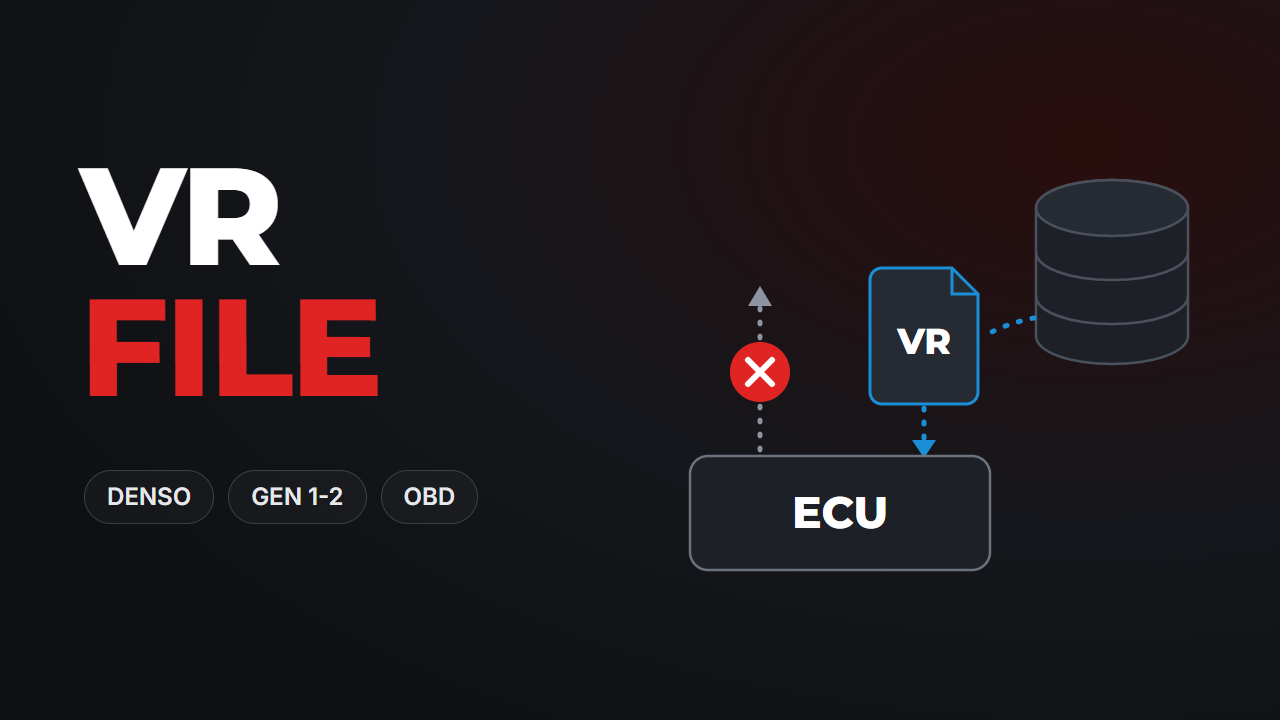
Request VR File (Gen1–2) is a request for the original factory file of a first or second generation Denso ECU that cannot be read over OBD, mostly on Toyota and Lexus. The file is matched to the ECU's software identifier, the options you need are built on it, and the result is written back over OBD. The price may change either way, and for rare versions there may be no file at all.
Why Denso Gen1–Gen2 ECUs cannot be read over OBD
The manufacturer has no use for reading. Software updates are only ever written, the ECU content is never pulled back, so on many ECUs an OBD read simply does not exist. Autotuner's help center puts it plainly: the manufacturer did not implement reading because it only needs to flash updates.
On Toyota and Lexus with Denso ECUs this is the normal situation. Alientech's public compatibility database gives many of these cars the same entry: no OBD read, virtual read only, and the real ECU content has to be read in boot mode on the bench with the housing opened. Those entries list processors marked 76F0… (the NEC/Renesas V850 family), which Gen 1 and Gen 2 units are built on.
In our catalogue the Denso generations are told apart by software size: Gen 1 runs from 368 KB to 1 MB, Gen 2 is 1.28, 1.5 or 2 MB. The newer Gen 3 and Gen 4 are 4 and 8 MB and are not part of this service.
What a VR file is
VR stands for virtual read. The tool connects over OBD, reads the ECU identifiers (software number, CAL ID) and downloads the factory original of that version from a database. In Autotuner's words, it is an original file that corresponds to the software number of the ECU actually installed in the car. Tuners request a VR file through a file service when their own tool has no virtual read or does not know that version.
How a VR file differs from a real read
VR file
- No need to remove or open the ECU.
- Always the factory original: if the ECU was tuned before, those edits will not be in the file.
- That makes it useless for a stock check.
- Rare versions may have no file.
Boot-mode read
- Shows what is actually written in the ECU.
- Does not depend on the version being in a database.
- The ECU has to be removed, opened and connected to on the board.
- Slower, and needs bench experience.
The VR file always being factory software rarely matters: the modified file built on it replaces the software in the ECU when written, and earlier edits go with the old software. What matters is that the software number matches exactly. Writing a file of the wrong version can leave the ECU unable to talk over OBD and the car unable to start.
Which cars this applies to
In Alientech's compatibility database, cars listed with no OBD read and only a virtual read include:
- D-4D diesels 1AD-FTV and 2AD-FTV, plus the 2.2 D-CAT (2AD-FHV): Avensis, Auris, Corolla, Corolla Verso, Verso, RAV4, Lexus IS 220d;
- Hilux, Hiace and Land Cruiser Prado with the 2KD-FTV and 1KD-FTV, Land Cruiser with the 1VD-FTV V8;
- Hilux, Fortuner and Innova with the 2GD-FTV and 1GD-FTV from the first model years;
- VVT-i petrol engines: Camry, Corolla, Yaris, Avensis, Land Cruiser and Land Cruiser Prado, Lexus IS, GS and LS.
The ECU generation is identified by software size and ECU number. If you are unsure which generation yours is, send the ECU number and software number with the order.
Why the price can change and the file may not exist
VR files come from databases of originals, looked up by software number. Common versions are there; rare, regional or very new ones may be missing, and the price depends on where the file has to come from. Even Autotuner, whose tool has virtual read built in, says that in rare cases the VR file is not available and advises looking for another reading method. If no file exists anywhere, the remaining option is a real read of the ECU in boot mode.
How to order a VR file
- Read the ECU identifiers over OBD: software number and CAL ID. Add the ECU number from the label; on Toyota it starts with 8966….
- Select REQUEST VR FILE (GEN1-2) in the portal and enter these numbers. Options such as DPF Off or EGR Off can go in the same order.
- Get the file, or the answer that this version is not in any database. The price of a VR file depends on its source and can differ either way.
- Write the finished file over OBD and clear faults in all modules.
If the car needs its sensors unplugged altogether, Denso ECUs have a separate solution: Solutions Full Disconnect.
Denso ECU that will not read over OBD? Select REQUEST VR FILE (GEN1-2) in the portal and enter the software number: we will find the original of that version if it exists in the databases.
Request a VR fileSupported ECUs for the REQUEST VR FILE (GEN1-2) service
Frequently asked questions
What does VR file mean?
It is a virtual read file: the factory original of the software version installed in the ECU. It is taken from a database by software number rather than read from the ECU.
Why can't a Toyota Denso ECU be read over OBD?
The manufacturer only ever writes updates and did not provide a read function. The real content of such an ECU is read in boot mode on the bench, with the housing opened.
What is the downside of a VR file compared with a real read?
It is always factory software and does not show what is currently written in the ECU. For tuning that rarely matters, but it is no use for a stock check.
Why can the price of a VR file differ?
The file is looked up in databases of originals by software number, and the cost depends on the source. So it can turn out lower or higher, and a rare version may not be found.
What if there is no VR file?
The remaining option is a real read of the ECU in boot mode. The same options can be built on that file.
What details do I need to order?
The software number and CAL ID shown by a scan tool over OBD, plus the ECU number from its label.
Can I order DPF Off or EGR Off at the same time?
Yes, options are selected in the same order and built on the VR file.