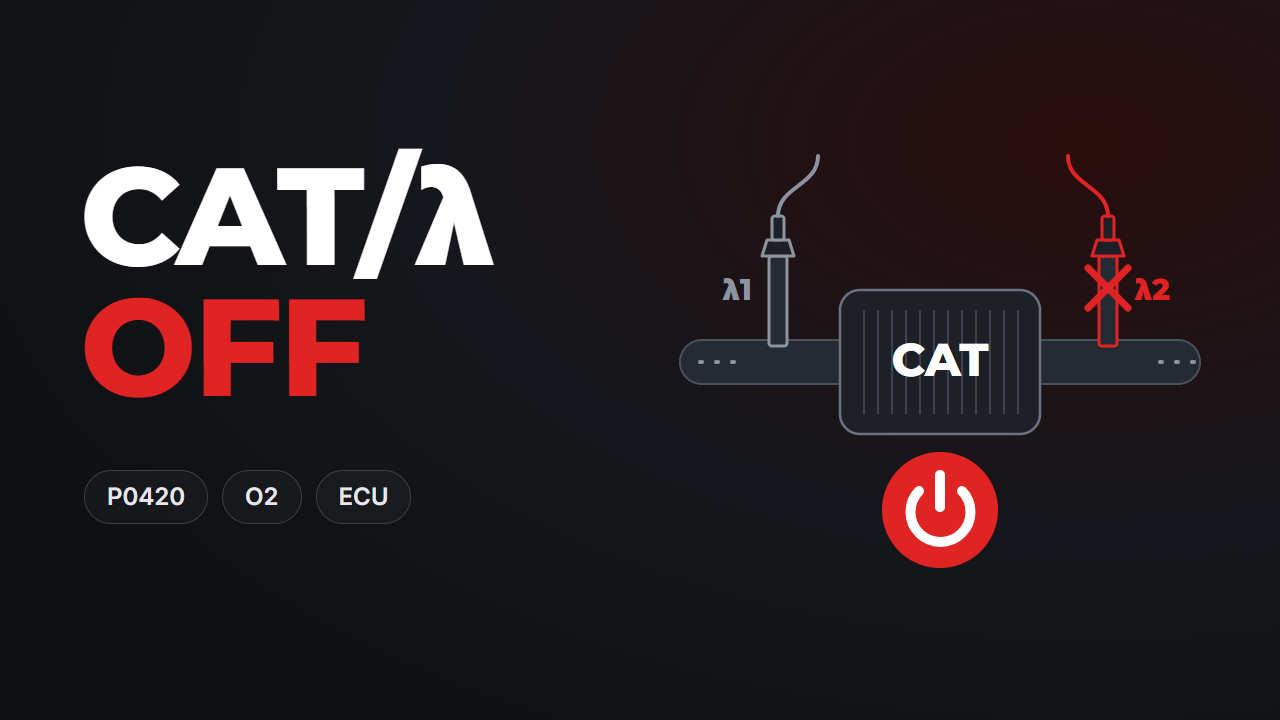
CAT/LAMBDA OFF switches off the second lambda sensor, the one behind the catalyst, in the software of a petrol ECU, together with the catalyst monitoring based on it. The file removes catalyst efficiency faults (P0420, P0430) and second-sensor faults, while the first sensor and mixture control keep working as before. For tuners: send us the original file and get a ready-to-flash file with corrected checksums, on average in 30–60 minutes.
How the catalyst and the two sensors work together
A three-way catalyst does three jobs at once: it burns off CO and hydrocarbons and reduces nitrogen oxides to nitrogen. It only manages this in a narrow window around λ = 1. Slightly lean and NOx stops being reduced, slightly rich and CO and hydrocarbons slip through. The active metals are platinum, palladium and rhodium, and cerium oxide in the coating acts as an oxygen buffer: it stores oxygen when the mixture is lean and releases it when it is rich.
Keeping the mixture in that window is the job of the first sensor, mounted ahead of the catalyst. The ECU corrects injection from its signal all the time, so the mixture swings around λ = 1, slightly rich, then slightly lean. The second sensor behind the catalyst is there to keep watch: the ECU compares its signal with the first one and decides whether the catalyst is still alive. On many engines the second sensor is also used to fine-tune the first control loop.
How the ECU checks the catalyst and where P0420 comes from
A healthy catalyst smooths out the mixture swings with its oxygen store. That is why in steady driving the second sensor's signal barely moves, while the first one swings several times a second. Once the coating is worn, there is not enough stored oxygen and the second sensor starts copying the first. From these signals the ECU works out a catalyst efficiency figure, and if it falls below the threshold it stores P0420 (bank 1) or P0430 (bank 2 on V engines) and turns on the Check Engine light. The ECU does not run this check all the time, only with a warm engine under steady conditions, so after an exhaust change the fault may not show up on the first drive.
The second sensor sees the same picture when there is no catalyst at all, or when the factory unit has been replaced with a sports catalyst that stores less oxygen. To the ECU it makes no difference: the signals look alike, so the catalyst is not working. In the EU, on-board diagnostics have required petrol cars to monitor the catalyst with a second sensor since 2000, so without a software change, removing the catalyst almost always ends with a Check Engine light.
Tuners usually call this a decat file or a rear O2 delete. Only the second sensor is switched off: the first one is still needed to control the mixture. Catalysts themselves have been mandatory on every new petrol car in the EU since 1993, the Euro 1 days.
Factory, sports catalyst or straight pipe: what the ECU sees
| What is in the exhaust | Second sensor signal | Is CAT/LAMBDA OFF needed |
|---|---|---|
| Healthy factory catalyst | almost flat | no |
| Worn factory catalyst | copies the first sensor | yes, if the catalyst is not replaced |
| ECE-approved sports catalyst | depends on the product | some makers state it runs without faults |
| Basic sports catalyst | swings get through | yes, if the ECU stores P0420 |
| Straight pipe, no catalyst | copies the first sensor | yes |
Simply unscrewing the second sensor without a file does not work either: the ECU immediately sees an open sensor and heater circuit and logs second-sensor faults. Without a catalyst, they arrive together with P0420.
When CAT/LAMBDA OFF is the answer, and when to repair first
The file solves it
- The catalyst came off for a sports downpipe or exhaust: Stage 2, track use.
- A sports catalyst is fitted and the ECU stores
P0420. - The catalyst is broken up or melted and a straight pipe went in its place.
- The catalyst is already gone, and the second sensor is removed or faulty.
Repair first
- Misfires: unburned fuel overheats and melts the catalyst, and the next one will go the same way.
- Oil or coolant consumption: phosphorus from oil and silicon from coolant poison the coating and the sensors.
- First-sensor and mixture faults: the file does not remove them, the first sensor keeps working.
Before ordering, read the fault codes and look at both sensor signals in live data. If the second one copies the first and there are no misfires, no oil consumption and no mixture faults, the catalyst is the problem. If there are misfires, they most likely killed the catalyst, and the engine needs fixing first.
What CAT/LAMBDA OFF changes in the software
Clearing P0420 with a scan tool is pointless: on the next drive the ECU compares the signals again and stores the same fault. So the logic in the file itself is changed.
| Function | Stock | After CAT/LAMBDA OFF |
|---|---|---|
| Second sensor operation: its signal and mixture fine-tuning from it | active | off |
| Catalyst efficiency monitoring by the second sensor | active | off |
| Second sensor diagnostics: circuit, response, heater | active | off |
| First sensor and mixture control based on it | active | active |
| Catalyst and second-sensor faults, Check Engine light | on a fault | do not appear |
The first sensor is not disabled: without it the ECU cannot hold the mixture around λ = 1. The rest of the calibration is unchanged too, so the file adds no power by itself. If the new exhaust calls for more power, add Stage 2. The same file can also take OPF/GPF Off, if the car has a petrol particulate filter, and Pop & Bangs. Diesels use their lambda sensor differently, and there is a separate LAMBDA OFF option for them.
Faults that go away together with catalyst and second-sensor monitoring:
| Code | Meaning |
|---|---|
P0420 / P0430 | Catalyst system efficiency below threshold (bank 1 / bank 2) |
P0136 / P0156 | Sensor 2: circuit malfunction (bank 1 / bank 2) |
P0137 / P0138 | Bank 1 sensor 2: low / high voltage |
P0139 | Bank 1 sensor 2: slow response |
P0140 | Bank 1 sensor 2: no activity detected |
P0141 / P0161 | Sensor 2: heater circuit (bank 1 / bank 2) |
Codes per SAE J2012. Bank 1 is the side of the engine with cylinder 1. Manufacturers may also use their own codes for the same faults. First-sensor faults are not on this list.
What to do with the exhaust and sensors
- The first sensor has to be healthy: the ECU holds the mixture with it, and the file does not remove its faults.
- The second sensor can stay in place after flashing, or be removed with its port blanked off: the ECU no longer uses or checks its signal.
- V engines: there are two catalysts and two second sensors, one per bank, and both are disabled.
- Pop & Bangs with a live catalyst. Fuel burning in the exhaust overheats the catalyst just like misfires do. Keep that in mind if the catalyst stays.
How to order the file
- Read the original file via OBD or on the bench with the tool you use. We need an unmodified stock file.
- Upload it to the portal and select CAT/LAMBDA OFF. You can add a Stage, OPF/GPF OFF or Pop & Bangs at the same time.
- Get the finished file with recalculated checksums, on average within 30–60 minutes.
- Flash the file, clear the faults and check after a drive that
P0420and the second-sensor faults have not come back.
The option is available for petrol ECUs including Bosch ME, MED, MEVD and MG, Continental Simos, SIM and EMS, Delco and Kefico, and the full list by make is below. If your ECU is not there, send the file with a request: we will check the software and tell you whether there is a solution.
Removing or disabling the catalyst increases CO, hydrocarbon and NOx emissions and changes the vehicle's emissions class. In the EU, the UK, the US and a number of other countries this is prohibited on public roads and may cause an inspection failure. The service is intended for tuners and is used where the law allows it: motorsport, off-road, export, vehicles not used on public roads. Responsibility for using the file lies with the vehicle owner.
Already have the original file? Upload it to the portal and select CAT/LAMBDA OFF, the finished file arrives on average in 30–60 minutes.
Order CAT/LAMBDA OffSupported ECUs for the CAT/LAMBDA OFF service
- Bosch ME17.1.6
- Bosch ME7.1
- Bosch ME7.1.1
- Bosch ME7.1.5
- Bosch ME7.5
- Bosch ME7.5.20
- Bosch ME7.5.5
- Bosch MED17.1
- Bosch MED17.1.1
- Bosch MED17.1.10
- Bosch MED17.1.21
- Bosch MED17.1.27
- Bosch MED17.1.6
- Bosch MED17.1.61
- Bosch MED17.1.62
- Bosch MED17.2.5
- Bosch MED17.5
- Bosch MED17.5.1
- Bosch MED17.5.2
- Bosch MED17.5.20
- Bosch MED17.5.21
- Bosch MED17.5.25
- Bosch MED17.5.5
- Bosch MED7.5.11
- Bosch MED9.1
- Bosch MED9.1.2
- Bosch MED9.1.5
- Bosch MED9.1.x
- Bosch MED9.5
- Bosch MED9.5.10
- Bosch MG1CS001
- Bosch MG1CS002
- Bosch MG1CS008
- Bosch MG1CS011
- Bosch MG1CS031
- Bosch MG1CS111
- Bosch MG1CS211
- Siemens/Continental SID603
- Siemens/Continental SIMOS 8.12
- Siemens/Continental Simos10.11
- Siemens/Continental Simos10.12
- Siemens/Continental Simos10.14
- Siemens/Continental Simos10.20
- Siemens/Continental Simos10.22
- Siemens/Continental Simos10.23
- Siemens/Continental Simos10.24
- Siemens/Continental Simos10.x
- Siemens/Continental Simos12
- Siemens/Continental Simos12.1
- Siemens/Continental Simos12.2
- Siemens/Continental Simos16.11
- Siemens/Continental Simos16.21
- Siemens/Continental Simos18.1
- Siemens/Continental Simos18.10
- Siemens/Continental Simos18.2
- Siemens/Continental Simos18.3
- Siemens/Continental Simos18.4
- Siemens/Continental Simos18.6
- Siemens/Continental Simos18.x
- Siemens/Continental Simos19.3
- Siemens/Continental Simos19.6
- Siemens/Continental Simos19.7
- Siemens/Continental Simos20.1.20
- Siemens/Continental Simos6.2
- Siemens/Continental Simos6.3
- Siemens/Continental Simos7.1
- Siemens/Continental Simos8.1
- Siemens/Continental Simos8.2
- Siemens/Continental Simos8.3
- Siemens/Continental Simos8.5
- Bosch ME17.2.1
- Bosch ME7.2
- Bosch ME9.2
- Bosch MED9.2.1
- Bosch MEV17.2.1
- Bosch MEV17.4.6
- Bosch MEVD17.2
- Bosch MEVD17.2.3
- Bosch MEVD17.2.4
- Bosch MEVD17.2.5
- Bosch MEVD17.2.6
- Bosch MEVD17.2.8
- Bosch MEVD17.2.9
- Bosch MEVD17.2.G
- Bosch MEVD17.2.H
- Bosch MEVD17.2.R
- Bosch MEVD17.2.X
- Bosch MG1CS001
- Bosch MG1CS003
- Bosch MG1CS024
- Bosch MG1CS049
- Bosch MG1CS201
- Siemens/Continental MDS81
- Siemens/Continental MS41
- Siemens/Continental MS42
- Siemens/Continental MS43
- Siemens/Continental MS45
- Siemens/Continental MSD46
- Siemens/Continental MSD80
- Siemens/Continental MSD81
- Siemens/Continental MSD85
- Siemens/Continental MSD87
- Siemens/Continental MSS45
- Siemens/Continental MSS52
- Siemens/Continental MSS54
- Siemens/Continental MSS54HP
- Siemens/Continental MSS60
- Siemens/Continental MSS65
- Siemens/Continental MSV70
- Siemens/Continental MSV80
- Siemens/Continental MSV90
- Bosch ME17.9.52
- Bosch ME17.9.53
- Bosch ME7.4.4
- Bosch ME7.4.5
- Bosch ME7.4.7
- Bosch MED17.4
- Bosch MED17.4.2
- Bosch MED17.4.4
- Bosch MEV17.4
- Bosch MEV17.4.2
- Bosch MEVD17.4.2
- Bosch MEVD17.4.4
- Bosch MG1CS032
- Bosch MG1CS042
- Bosch MG1CS069
- Ford EEC-VI
- Siemens/Continental V56.12
- Siemens/Continental VD56.1
- Valeo J34P
- Valeo JP34
- Valeo V46.11
- Valeo V46.12
- Valeo V46.13
- Valeo VD46.1
- Valeo VD56.1
- Bosch ME17.9.20
- Sagem S3000
- Siemens/Continental EMS3110
- Siemens/Continental EMS3125
- Siemens/Continental EMS3132
- Siemens/Continental EMS3140
- Siemens/Continental EMS3141
- Siemens/Continental EMS3150
- Siemens/Continental EMS3155
- Siemens/Continental EMS3160
- Siemens/Continental EMS3161
- Siemens/Continental EMS3180
- Siemens/Continental EMS3181
- Siemens/Continental SIRIUS 32
- Valeo V40
- Valeo V42
- Valeo V50.1
- Bosch ME17.0.3
- Bosch ME9.0C
- Bosch MED17
- Bosch MED17.0
- Bosch MED17.0.1
- Bosch MED17.0.7
- Bosch MED17.2.2
- Bosch MEDG17.0
- Bosch MG1CS011
- Ford EEC-V
- Ford EEC-VI
- Ford EECV
- Siemens/Continental 5WY8
- Siemens/Continental EMS
- Siemens/Continental EMS2102
- Siemens/Continental EMS24xx
- Siemens/Continental EMS2510
- Siemens/Continental EMS2511
- Siemens/Continental EMS25xx
- Siemens/Continental SIM21
- Siemens/Continental SIM22
- Siemens/Continental SIM24
- Bosch ME17.9.1
- Bosch ME17.9.11
- Bosch ME17.9.11.1
- Bosch ME17.9.21
- Bosch ME17.9.21.1
- Bosch MED17.9.8
- Kefico CPEGD2.20.1
- Kefico CPEGD2.20.2
- Kefico CPEGD2.20.3
- Kefico CPEGD2.20.4
- Kefico CPEGD2.20.x
- Kefico CPEGD3.20.1
- Kefico CPEGP3.20.1
- Kefico CPGPSH3.26.1
- Kefico MEG17.9.12
- Kefico MEG17.9.13
- Siemens/Continental SIM2K-140
- Siemens/Continental SIM2K-141
- Siemens/Continental SIM2K-142
- Siemens/Continental SIM2K-240
- Siemens/Continental SIM2K-240R
- Siemens/Continental SIM2K-241
- Siemens/Continental SIM2K-242
- Siemens/Continental SIM2K-245
- Siemens/Continental SIM2K-250
- Siemens/Continental SIM2K-251
- Siemens/Continental SIM2K-253
- Siemens/Continental SIM2K-259
- Siemens/Continental SIM2K-341
- Siemens/Continental SIMK-43
- Bosch ME17.9.1
- Bosch ME17.9.11
- Bosch ME17.9.11.1
- Bosch ME17.9.21
- Bosch ME17.9.21.1
- Bosch MED17.9.8
- Bosch MEG17.9.21
- Bosch MEG17.9.8
- Kefico CPEGD2.20.1
- Kefico CPEGD2.20.2
- Kefico CPEGD2.20.3
- Kefico CPEGD2.20.4
- Kefico CPEGD2.20.x
- Kefico CPEGD3.20.1
- Kefico CPEGP3.20.1
- Kefico CPGPSH3.26.1
- Kefico E6T348XX
- Kefico MEG17.9.12
- Kefico MEG17.9.13
- Siemens/Continental SIM2K-140
- Siemens/Continental SIM2K-141
- Siemens/Continental SIM2K-142
- Siemens/Continental SIM2K-240
- Siemens/Continental SIM2K-240R
- Siemens/Continental SIM2K-241
- Siemens/Continental SIM2K-242
- Siemens/Continental SIM2K-245
- Siemens/Continental SIM2K-250
- Siemens/Continental SIM2K-251
- Siemens/Continental SIM2K-253
- Siemens/Continental SIM2K-259
- Siemens/Continental SIM2K-260
- Siemens/Continental SIM2K-341
- Bosch EDC17C45
- Bosch ME17.9.20
- Bosch ME17.9.5
- Bosch ME17.9.51
- Bosch ME17.9.64
- Hitachi SH72531
- Hitachi SH72533 Gen1
- Hitachi SH72533 Gen2
- Siemens/Continental EMS3125
- Siemens/Continental EMS3140
- Siemens/Continental EMS3141
- Siemens/Continental EMS3150
- Siemens/Continental EMS3155
- Siemens/Continental EMS3160
- Siemens/Continental EMS3161
- Valeo V50.1
- Bosch ME1.5.5
- Bosch ME17.3.0
- Bosch ME17.9.6
- Bosch ME7
- Bosch ME7.6.2
- Bosch ME7.6.3
- Bosch ME7.6.4
- Bosch ME7.6H4
- Bosch ME9
- Bosch ME9.6.1
- Bosch MG1CA811
- Bosch MG1CS032
- Bosch MG1CS042
- Delco E39
- Delco E39A
- Delco E78
- Delco E80
- Delco E83
- Delco E84
- Siemens/Continental SIMTEC 70
- Siemens/Continental SIMTEC 75
- Siemens/Continental SIMTEC 81
- Siemens/Continental V56.12
- Siemens/Continental VD56.1
- Valeo VD46.1
- Valeo VD56.1
- Bosch ME17.9.52
- Bosch ME17.9.53
- Bosch ME7.4.4
- Bosch ME7.4.5
- Bosch ME7.4.7
- Bosch MED17.4
- Bosch MED17.4.2
- Bosch MED17.4.4
- Bosch MEV17.4
- Bosch MEV17.4.2
- Bosch MEVD17.4.2
- Bosch MEVD17.4.4
- Bosch MG1CS032
- Bosch MG1CS042
- Bosch MG1CS069
- Siemens/Continental V56.12
- Siemens/Continental VD56.1
- Valeo J34P
- Valeo JP34
- Valeo V46.11
- Valeo V46.12
- Valeo V46.13
- Valeo VD46.1
- Valeo VD56.1
- Bosch EDC17C45
- Bosch ME17.9.20
- Bosch ME7.6.3
- Siemens/Continental EMS3125
- Siemens/Continental EMS3140
- Siemens/Continental EMS3141
- Siemens/Continental EMS3150
- Siemens/Continental EMS3155
- Siemens/Continental EMS3160
- Siemens/Continental EMS3161
- Siemens/Continental SIRIUS 32
- Valeo V40
- Valeo V42
- Valeo V50.1
- Bosch ME7.5
- Bosch ME7.5.20
- Bosch MED17.1
- Bosch MED17.1.21
- Bosch MED17.1.27
- Bosch MED17.1.61
- Bosch MED17.2.5
- Bosch MED17.5
- Bosch MED17.5.1
- Bosch MED17.5.2
- Bosch MED17.5.20
- Bosch MED17.5.21
- Bosch MED17.5.25
- Bosch MED17.5.5
- Bosch MED9.1
- Bosch MED9.1.x
- Bosch MED9.5
- Bosch MED9.5.10
- Bosch MG1CS001
- Bosch MG1CS011
- Bosch MG1CS111
- Siemens/Continental Simos10.11
- Siemens/Continental Simos10.12
- Siemens/Continental Simos10.14
- Siemens/Continental Simos10.20
- Siemens/Continental Simos10.22
- Siemens/Continental Simos10.23
- Siemens/Continental Simos10.24
- Siemens/Continental Simos10.x
- Siemens/Continental Simos12.1
- Siemens/Continental Simos12.2
- Siemens/Continental Simos18.1
- Siemens/Continental Simos18.10
- Siemens/Continental Simos18.2
- Siemens/Continental Simos18.3
- Siemens/Continental Simos18.6
- Siemens/Continental Simos19.3
- Siemens/Continental Simos20.1.20
- Siemens/Continental Simos7.1
- Bosch ME7.5
- Bosch ME7.5.20
- Bosch MED17.1.21
- Bosch MED17.1.27
- Bosch MED17.1.61
- Bosch MED17.2.5
- Bosch MED17.5
- Bosch MED17.5.1
- Bosch MED17.5.2
- Bosch MED17.5.20
- Bosch MED17.5.21
- Bosch MED17.5.25
- Bosch MED17.5.5
- Bosch MED7.5.11
- Bosch MED9.1
- Bosch MED9.1.x
- Bosch MED9.5
- Bosch MED9.5.10
- Bosch MG1CS001
- Bosch MG1CS011
- Bosch MG1CS111
- Siemens/Continental Simos10.11
- Siemens/Continental Simos10.12
- Siemens/Continental Simos10.14
- Siemens/Continental Simos10.20
- Siemens/Continental Simos10.22
- Siemens/Continental Simos10.23
- Siemens/Continental Simos10.24
- Siemens/Continental Simos10.x
- Siemens/Continental Simos12
- Siemens/Continental Simos12.1
- Siemens/Continental Simos12.2
- Siemens/Continental Simos18.1
- Siemens/Continental Simos18.2
- Siemens/Continental Simos18.3
- Siemens/Continental Simos18.6
- Siemens/Continental Simos19.3
- Siemens/Continental Simos20.1.20
- Siemens/Continental Simos7.1
- Bosch ME7.1
- Bosch ME7.1.1
- Bosch ME7.5
- Bosch ME7.5.10
- Bosch ME7.5.20
- Bosch MED17.1
- Bosch MED17.1.21
- Bosch MED17.1.27
- Bosch MED17.1.6
- Bosch MED17.1.61
- Bosch MED17.2.5
- Bosch MED17.5
- Bosch MED17.5.1
- Bosch MED17.5.2
- Bosch MED17.5.20
- Bosch MED17.5.21
- Bosch MED17.5.25
- Bosch MED17.5.5
- Bosch MED7.5.11
- Bosch MED9.1
- Bosch MED9.1.5
- Bosch MED9.1.x
- Bosch MED9.5
- Bosch MED9.5.10
- Bosch MG1CS001
- Bosch MG1CS002
- Bosch MG1CS011
- Bosch MG1CS111
- Siemens/Continental SID603
- Siemens/Continental Simos10.11
- Siemens/Continental Simos10.12
- Siemens/Continental Simos10.14
- Siemens/Continental Simos10.20
- Siemens/Continental Simos10.22
- Siemens/Continental Simos10.23
- Siemens/Continental Simos10.24
- Siemens/Continental Simos10.x
- Siemens/Continental Simos12.1
- Siemens/Continental Simos12.2
- Siemens/Continental Simos16.11
- Siemens/Continental Simos16.21
- Siemens/Continental Simos18.1
- Siemens/Continental Simos18.10
- Siemens/Continental Simos18.2
- Siemens/Continental Simos18.3
- Siemens/Continental Simos18.4
- Siemens/Continental Simos18.6
- Siemens/Continental Simos18.x
- Siemens/Continental Simos19.3
- Siemens/Continental Simos20.1.20
- Siemens/Continental Simos7.1
- Siemens/Continental Simos8.3
- Siemens/Continental Simos8.5
Frequently asked questions
Does the front lambda sensor keep working?
Yes. The ECU holds the mixture around λ = 1 with it, and its control and diagnostics stay in place. What is switched off is the second sensor and the catalyst monitoring based on it.
Can the rear O2 sensor be removed after flashing?
Yes. The second sensor is switched off in the software: the ECU neither uses nor checks its signal. Blank off the sensor port.
Should I flash the file if P0420 appeared with the factory catalyst?
Find the cause first. If the catalyst is simply worn out with age, the file solves it. If misfires or oil consumption killed it, a new catalyst will go the same way unless the engine is fixed, and the file does not cure those faults.
Do I need the file with a sports catalyst?
If the ECU stores P0420, yes: a sports catalyst stores less oxygen, so the second sensor sees the mixture swings. Some certified sports catalysts are sold by their makers as running without faults.
Will power or fuel consumption change after CAT/LAMBDA OFF?
The file leaves the engine calibration alone: the mixture is still controlled by the first sensor. More power for a new exhaust comes from Stage 2, which can go into the same order.
Is a decat file the same as a rear O2 delete?
In practice, yes. Both terms mean switching off catalyst monitoring and the second sensor, while the first sensor keeps controlling the mixture.
Are both banks of a V engine disabled?
Yes. These engines have two catalysts and two second sensors, and both are disabled. Bank 2 faults are P0430, P0156 and P0161.
Can the factory software be restored?
Yes, as long as the original file is saved and the catalyst and second sensor are in place: just flash the stock file back. Always keep the original.
Is removing the catalyst legal?
Not on public roads in the EU, the UK, the US and many other countries. The service is intended for motorsport, off-road, export and vehicles not used on public roads; responsibility for using the file lies with the owner.