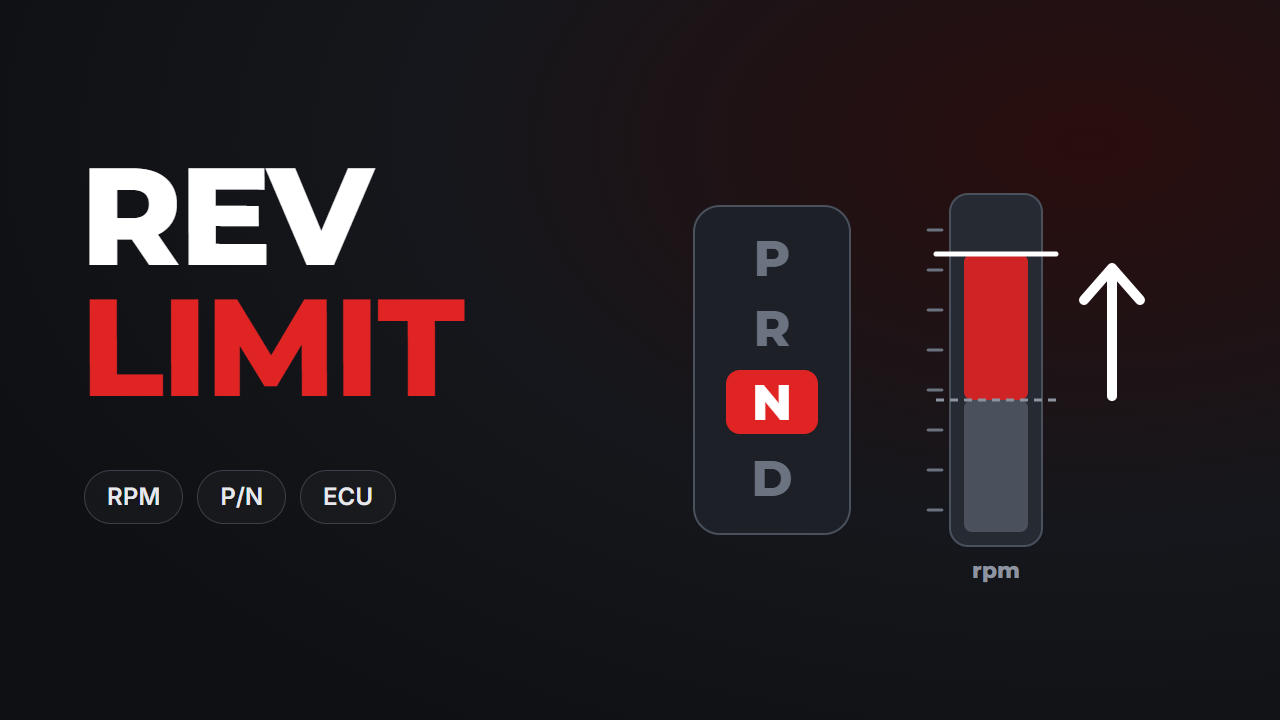
Rev Limiter Deactivation removes the separate rev limit that many ECUs apply while the car is standing in P or N. With the car standing, the engine stops at, say, 4000 rpm, even though on the move it revs to the red line. After the change it revs to the main limit when stationary too. On request the main limit itself can be raised, but only within what the engine can take: the rev limiter is never removed altogether. For tuners: send us the original file and get a ready-to-flash file with corrected checksums, on average in 30–60 minutes.
Why the engine will not rev when the car is standing
An ECU has more than one rev limiter. Besides the main limit that the red line marks, many ECUs hold a separate, lower limit for a car that is not moving. To know that, the ECU looks at the gear selector or neutral switch and at road speed. In Saab's documentation for the Bosch EDC16, for example, the engine ECU gets the P/R/N/D position from the transmission control unit and the wheel speeds from the ESP. A Ford calibration on Bosch MG1 even has its own rev-control gains for P and N.
Why manufacturers do it is clear from a patent by JATCO, the automatic transmission supplier. Keep revs low in N, and engaging D does not send a shock through the driveline, the car does not lurch off and the engine does not roar for nothing. Owners of the Land Rover LR4 (Discovery 4) with the supercharged V6 hit 4000 rpm in P and N, while on the move the engine revs higher, with no fault codes logged.
What other rev limits the ECU has
The main limit often works in two stages. First a soft limiter cuts torque on the approach, so revs settle against the mark smoothly. If that is not enough, a fuel cut takes over: in Saab's documentation for the Motronic ME9 on the 2.8T V6 it sits above 6600 rpm. How the engine behaves at the limit is changed by a separate option, Hard Cut Limit.
Apart from the main limit and the stationary limit, the calibration holds protective limits. Whichever active limit is lowest wins, and Rev Limiter Deactivation leaves all of them alone.
The same Ford calibration also has limits to protect the high-pressure fuel pump (2000 rpm) and to keep the injector driver from overheating (6000), and with the pedal unplugged entirely the engine will not rev past 2000.
Stationary limit or limp mode
Before ordering a file, make sure the revs are capped by the factory logic and not by a fault reaction.
Factory stationary limit
- Revs stop only in P or N with the car standing.
- On the move the engine revs to the red line.
- No fault codes and no warning light.
Limp mode
- Revs will not climb on the move either, in any gear.
- There are fault codes or a warning light.
- The limit appeared suddenly and was not there before.
In the second case a file will not help, the car needs diagnosis. The ECU may cap revs because of a faulty pedal sensor, overheating or an oil pressure problem. If the road speed or neutral signal does not reach it, it may assume the car is standing and keep the stationary limit on all the time.
What changes in the file
| Function | Stock | After the option |
|---|---|---|
| Stationary rev limit (P or N) | below the main limit | up to the main limit |
| Main rev limit | factory | factory, higher by agreement |
| Soft limiter and fuel cut | active | active |
| Protective limits: temperatures, oil pressure, faults | active | active |
| Top speed limit | factory | factory |
The rest of the calibration stays as it was and checksums are corrected. Road speed is capped by a different function, and that is what VMAX OFF raises. Rev Limiter Deactivation, VMAX OFF and Stage 1 can all go into one file.
How far the main limit can go
The red line is the engine's safety margin. Inertia forces on the pistons and rods grow with the square of engine speed: 10 % more revs means 21 % more inertia load on the rods and bearings. Mean piston speed grows linearly: with a 90 mm stroke it is 13.5 m/s at 4500 rpm and 15 m/s at 5000. At high revs the valve springs can no longer close the valves in time, so compression drops, the engine misfires and in the worst case a valve meets a piston.
That is why we raise the main limit only by agreement, taking into account the engine and what has been done to it. A higher limit adds no power by itself; it only lets you hold a gear longer. And no limiter can save an engine from a missed downshift: if too low a gear goes in, the wheels drive the engine past any limit. The ECU may then log P0219, engine overspeed condition.
How to order
- Read the original file over OBD or on the bench with the tool you use. It has to be unmodified stock.
- Upload the file to the portal and choose REV LIMITER DEACTIVATION. In the comment say where the engine stops now: only when stationary or on the move too, at what figure, and whether the main limit should go up.
- Get the finished file with corrected checksums, on average in 30–60 minutes.
- Flash the file and test with the engine warm: a short rev when stationary, without holding it on the limiter.
Send the file with a request and we will check whether there is a solution for your ECU.
Revving a stationary engine hard for long loads it for no benefit, and a loud engine on the limiter on public roads or in residential areas may breach noise rules. A raised main limit reduces the engine's safety margin, and no limiter can prevent an over-rev from a wrong gear. Use the option where the rules allow it: on a dyno, a track or a closed course. Responsibility for using the file lies with the vehicle owner.
Already have the file? Upload it to the portal and choose REV LIMITER DEACTIVATION, the finished file arrives on average in 30–60 minutes.
Order Rev Limiter DeactivationFrequently asked questions
Why won't the engine rev to the red line when the car is standing?
Many ECUs hold a separate, lower limit while the car stands in P or N. That way the manufacturer spares the driveline a shock when a gear goes in and stops the engine from roaring for nothing.
Is it a fault?
If revs stop only when stationary, while on the move the engine reaches the red line with no fault codes, it is factory logic. If the limit is there on the move too or a warning light is on, it is limp mode and the car needs diagnosis.
Can the limit be raised on the move as well?
Yes, by agreement and within what the engine can take. A higher limit adds no power by itself.
Can the rev limiter be removed completely?
No. Without a limit the engine risks valve float and broken connecting rods at high revs, so a limiter always stays.
How is this different from Hard Cut Limit?
Rev Limiter Deactivation changes the threshold, where revs stop. Hard Cut Limit changes the character, how the engine behaves at the limit. Both can go into one file.
Will overheating and oil pressure protection stay?
Yes. Protective limits for temperatures, oil pressure and faults are not changed.
Will this remove the top speed limit?
No, road speed is limited by a different function. There is a separate VMAX OFF option for it.
Can it be returned to stock?
Yes, just flash the saved original file.
Is there a solution for my ECU?
Send the file with a request: we will check the software and tell you whether the rev limit can be changed on that ECU.