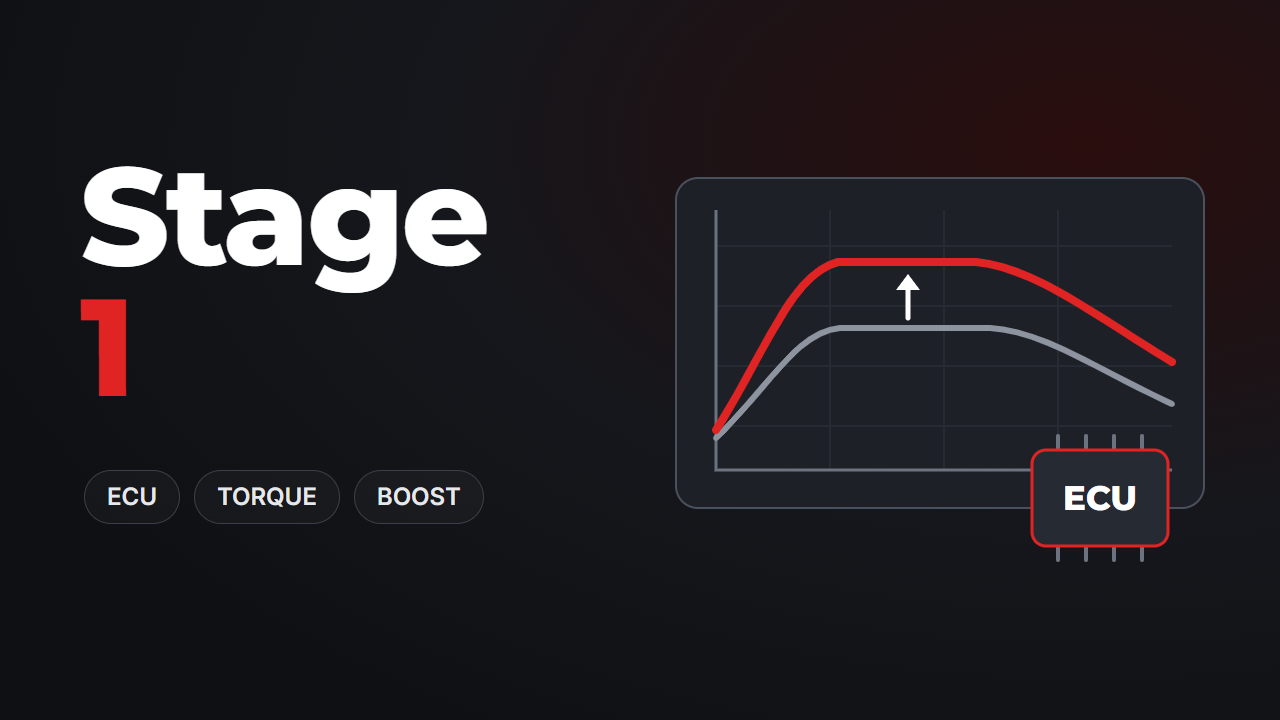
Stage 1 is an ECU calibration for stock hardware: the torque, boost, fuel and timing maps are reworked and the factory limiters raised, with no mechanical changes. On turbocharged engines that usually means 15–30% more power, on naturally aspirated ones no more than 5–10%. Some gearboxes, DSG among them, have their own Stage 1: a shift calibration. For tuners: send the original file and get a ready-to-flash file with corrected checksums, on average in 30–60 minutes.
Where the headroom in a stock engine comes from
Factory calibrations are written for the worst case. The engine has to run the same in summer heat and at altitude, on fuel of varying quality, meet emissions limits and outlast its design life with margin to spare. For that the software carries separate limiters: for ambient pressure, for intake air, coolant and oil temperatures, for smoke and for the gearbox.
Sometimes it is simpler than that: one engine is sold in several power outputs, and the difference comes down to software or small parts such as injectors and the intercooler. Stage 1 takes part of that margin, raising the limits to where the engine, turbo and drivetrain still have reserve. The hardware stays stock, so the gain is capped by what that hardware can do.
How the ECU decides how much torque to deliver
On control units from the last twenty-odd years (Bosch ME7 and MED17, EDC16 and EDC17, Continental SID and Simos and others) the accelerator pedal does not control fuelling directly. Pedal position and engine speed are turned into a torque request in Nm. The request is checked against a set of limiters and the ECU takes the lowest value. Only then is torque turned into commands: how much fuel to inject, what boost and timing to run. Older EDC15 units are built around injection quantity rather than torque, but their limiters do the same job.
The limiters a torque request passes through:
- Gearbox protection. The engine ECU holds torque limits, including per gear, and the transmission control unit can ask for a torque cut over CAN, for example during a shift.
- Smoke limit (diesel). How much fuel can be burned in the air that is in the cylinder right now. Until the turbo spools up, this is the limit that holds torque down at low rpm.
- Overheating. Based on calculated and measured temperatures, a diesel cuts fuel, while a turbo petrol engine enriches the mixture to keep exhaust temperature within limits.
- Limiters and corrections. The rev and speed limiters and the correction for ambient pressure, in other words for altitude.
From there diesel and petrol go separate ways. A diesel ECU converts torque into injection quantity per stroke and, based on it, picks rail pressure, injection start and duration, and the boost target. A petrol ECU works out the cylinder filling needed for that torque, and from it the boost to run and the throttle opening. Ignition timing is set with an eye on knock.
What changes in the file and what stays
Stage 1 edits calibration data: maps and limiters, while the ECU's algorithms stay the same. A typical file has anywhere from five to twenty maps changed, depending on the ECU and the engine.
| What is changed | Diesel | Petrol |
|---|---|---|
| Torque | pedal map, torque limits, torque-to-fuel conversion | pedal map, torque limits, torque-to-filling conversion |
| Air | boost target and limits, variable turbine geometry control | boost target and limits, wastegate, maximum filling |
| Fuel and timing | rail pressure, smoke limit, start of injection | ignition timing, full-load lambda |
| Temperature protection | stays in place | stays in place |
Sensors and actuators stay as they are. EGR, the particulate filter, the catalytic converter and AdBlue keep working unless they are disabled with separate options. The rev limiter and the speed limiter are left at factory values. The gearbox control unit is flashed separately: it keeps its own torque limit whatever is written to the engine ECU.
How much Stage 1 adds
Turbo diesel
- typically +15–30% power
- the torque gain shows most in the mid-range
- the limits are the turbo, the injectors and the clutch
Turbo petrol
- typically +15–25%
- lower-output versions that differ from the top version only in software can gain more
- the limits are knock and intake air temperature after the intercooler
- needs the fuel octane the file was written for
Naturally aspirated
- around 5–10%, often less: there is no boost to raise, and the engine cannot take in more air without hardware changes
- throttle response improves more noticeably than peak power
These are guidelines: the result depends on the engine, its condition, the fuel and the gearbox. Engines that already run close to their limit from the factory gain less. Figures for specific engines are collected in our Stage 1 and Stage 2 figures database.
What to check before flashing
Software does not fix faults, and the extra load exposes them quickly. Before Stage 1, go through this list:
- Fault codes in all modules and their history, especially for boost, rail pressure, misfires and knock.
- Boost under load: actual against specified, intake leaks, MAF readings.
- Diesel: injector corrections, rail pressure actual and specified, DPF differential pressure and ash load, EGR condition.
- Petrol: spark plugs and coils, knock retard, lambda adaptations.
- Clutch: in a high gear from low rpm, floor the throttle. If the revs rise faster than road speed, the clutch is slipping, and the tune will make it worse.
- High-mileage engines: compression and oil condition.
Save the original file before flashing, ideally a full read. It is your way back to stock and the base for any later tune. Stage 1 is made from the original file, so if you are not sure the ECU still runs factory software, order a Check Stock or Not first.
What to look at in the logs after flashing
Clear the faults and log a long pull in third or fourth gear. Watch these values:
- Boost: actual follows specified with no dips or overshoot.
- Rail pressure (diesel): actual holds specified all the way to the limiter.
- Knock retard (petrol): occasional events are normal; constant retard on several cylinders means checking the fuel and the plugs.
- Intake air temperature and, if there is a sensor, exhaust gas temperature.
- Fault codes after the drive, including in the gearbox module.
If boost falls short or the engine goes into limp mode, the cause is most often found in the hardware: an intake leak, sticking turbine vanes, a weak high-pressure pump. Describe what the log shows in the order and we will look into it.
Clutch, gearbox and engine life
Extra torque loads everything behind the engine: the clutch and dual-mass flywheel, the gearbox, the driveshafts. A worn clutch will be the first thing to slip after Stage 1, so check it before flashing.
Automatic and dual-clutch gearboxes have a rated torque limit. VW, for example, specifies the 7-speed DSG 0AM (DQ200) for engines up to 250 Nm and the 6-speed 02E (DQ250) for up to 350 Nm depending on the engine. The gearbox control unit knows its limit and will still restrict torque if the engine asks for more. The limit inside the gearbox is raised by a separate option, Torque Unlock, and that only makes sense if the particular gearbox has margin.
Engine life and fuel use depend mostly on how the car is driven. Use all of the extra power all the time and the turbo, pistons and clutch wear faster, and consumption goes up, because extra power comes from extra fuel. Driven as before, the car uses about as much fuel as it did. Keep servicing in mind as well: a dealer may spot modified software and refuse warranty on the engine or gearbox, and a software update at the dealer often wipes the tune.
Stage 1 for the gearbox
In our database Stage 1 is also available for some gearbox control units, for example DSG DQ38x and DQ500. For a gearbox it is a separate file read from the TCU: a calibration of shifting and clutch pressures for an engine that makes more torque after its own tune. A stock gearbox is set up for factory torque and for economy: in D many gearboxes change up early, and clutch pressures are calculated for the factory engine.
What can be changed depends on the gearbox and its software version. For DSG (DQ250, DQ381, DQ500) and ZF 8HP automatics, a gearbox Stage 1 usually covers:
| Setting | What changes |
|---|---|
| Shift points | in D and S, matched to the new torque curve so the gearbox does not change up too early |
| Shift speed | shorter shifts and quicker response to the paddles |
| Manual mode | the automatic upshift at the limiter and the kickdown that get in the way of spirited driving |
| Launch control | launch rpm, where the gearbox supports it |
| Clutch pressure | clamping force matched to the extra torque so the clutches do not slip |
The torque limit inside the gearbox is raised by the separate Torque Unlock option covered above. If only the pressures need changing, there is Oil Pressure Optimizations, which also explains in detail how the gearbox chooses its pressure. Before flashing, check the gearbox oil level and condition and the TCU fault codes; after flashing, reset the adaptations so the gearbox can relearn.
When Stage 1 is not the right choice
If the car already has a downpipe, a bigger intercooler or a different turbo, a stock-hardware calibration was not written for it, and you need Stage 2. When fuel consumption matters more than performance, Eco Tuning is the better fit: it adds torque at low and middle rpm so the car can run at lower revs. EGR, DPF and other disables are done in the same file, in one order with Stage 1.
How to order the file
- Read the original file via OBD or on the bench with the tool you use, and keep a copy.
- Upload it to the portal and select STAGE 1. In the comment, state the gearbox (manual, DSG, automatic), the fuel (95 or 98 RON) and anything on the car that is no longer stock. Add any disables to the same order.
- Get the finished file with recalculated checksums, on average within 30–60 minutes.
- Flash the file, clear the faults and check the engine under load with a log.
If your ECU is not in the list below, send the file with a request: we will check the software and tell you whether Stage 1 is possible.
Already have the file? Upload it to the portal and select STAGE 1, the finished file arrives on average in 30–60 minutes.
Order Stage 1Supported ECUs for the STAGE 1 service
- Bosch EDC15C7
- Bosch EDC16C08
- Bosch EDC16C39 (CAN)
- Bosch EDC16C39 (K-Line)
- Bosch EDC16C8
- Bosch EDC17C49
- Bosch EDC17C69
- Bosch EDC17C79
- Bosch ME17.3.0
- Marelli MJD6
- Marelli MJD8
- Marelli MJD8F2
- Marelli MJD8F3
- Marelli MJD9DF
- Siemens/Continental GPEC4
- Siemens/Continental GPEC4LM
- ZF 8HP50
- ZF 8HP75
- ZF 9HP48-948TE
- Bosch EDC16C1
- Bosch EDC17CP02
- Bosch EDC17CP45
- Bosch MD1CP002
- Bosch MD1CP032
- Bosch MEVD17.2.6
- Bosch MEVD17.2.8
- Bosch MEVD17.2.G
- Bosch MG1CS003
- Bosch MG1CS024
- Bosch MG1CS049
- Bosch MG1CS201
- Siemens/Continental MSD80
- Siemens/Continental MSD81
- Siemens/Continental MSD85
- Temic DKG436 gen1
- ZF 6HP EGS
- ZF 8HPxx
- ZF 8HPxx-Gen3
- Bosch DQ38x
- Bosch DQ500 (MQB)
- Bosch EDC15P+
- Bosch EDC15VM+
- Bosch EDC16C4
- Bosch EDC16CP34
- Bosch EDC16U1
- Bosch EDC16U31
- Bosch EDC16U34
- Bosch EDC17C46
- Bosch EDC17C54
- Bosch EDC17C64
- Bosch EDC17C74
- Bosch EDC17CP04
- Bosch EDC17CP14
- Bosch EDC17CP20
- Bosch EDC17CP24
- Bosch EDC17CP44
- Bosch EDC17CP54
- Bosch EDC17CP74
- Bosch MD1
- Bosch MD1CP004
- Bosch MD1CP014
- Bosch MD1CS004
- Bosch MD1CS014
- Bosch ME17.1.6
- Bosch ME7.1
- Bosch ME7.1.1
- Bosch ME7.1.5
- Bosch ME7.5
- Bosch ME7.5.20
- Bosch ME7.5.5
- Bosch MED17.1
- Bosch MED17.1.1
- Bosch MED17.1.10
- Bosch MED17.1.21
- Bosch MED17.1.27
- Bosch MED17.1.6
- Bosch MED17.1.61
- Bosch MED17.1.62
- Bosch MED17.2.5
- Bosch MED17.5
- Bosch MED17.5.1
- Bosch MED17.5.2
- Bosch MED17.5.20
- Bosch MED17.5.21
- Bosch MED17.5.25
- Bosch MED17.5.5
- Bosch MED7.5.11
- Bosch MED9.1
- Bosch MED9.1.2
- Bosch MED9.1.5
- Bosch MED9.1.x
- Bosch MED9.5
- Bosch MED9.5.10
- Bosch MG1CS001
- Bosch MG1CS002
- Bosch MG1CS008
- Bosch MG1CS011
- Bosch MG1CS031
- Bosch MG1CS111
- Bosch MG1CS211
- Bosch Tiptronic
- Delphi DCM6.2V
- Siemens/Continental DL800
- Siemens/Continental DQ500
- Siemens/Continental PCR2.1
- Siemens/Continental PPD1.x
- Siemens/Continental SID603
- Siemens/Continental SIMOS 8.12
- Siemens/Continental Simos10.11
- Siemens/Continental Simos10.12
- Siemens/Continental Simos10.14
- Siemens/Continental Simos10.20
- Siemens/Continental Simos10.22
- Siemens/Continental Simos10.23
- Siemens/Continental Simos10.24
- Siemens/Continental Simos10.x
- Siemens/Continental Simos12
- Siemens/Continental Simos12.1
- Siemens/Continental Simos12.2
- Siemens/Continental Simos16.11
- Siemens/Continental Simos16.21
- Siemens/Continental Simos18.1
- Siemens/Continental Simos18.10
- Siemens/Continental Simos18.2
- Siemens/Continental Simos18.3
- Siemens/Continental Simos18.4
- Siemens/Continental Simos18.6
- Siemens/Continental Simos18.x
- Siemens/Continental Simos19.3
- Siemens/Continental Simos19.6
- Siemens/Continental Simos19.7
- Siemens/Continental Simos20.1.20
- Siemens/Continental Simos6.2
- Siemens/Continental Simos6.3
- Siemens/Continental Simos7.1
- Siemens/Continental Simos8.1
- Siemens/Continental Simos8.2
- Siemens/Continental Simos8.3
- Siemens/Continental Simos8.5
- Temic DL382
- Temic DL501
- Temic DQ200
- Temic DQ200 (MQB)
- Temic DQ200G2
- Temic DQ250 (MQB)
- Temic DQ250C
- Temic DQ250E
- Temic DQ250F
- Temic DQ400E
- ZF AL-552
- ZF AL552
- ZF ALx51
- Bosch BMS46
- Bosch DDE4.0
- Bosch EDC15
- Bosch EDC15C4
- Bosch EDC15M
- Bosch EDC16C1
- Bosch EDC16C35
- Bosch EDC16CP35
- Bosch EDC17C06
- Bosch EDC17C41
- Bosch EDC17C50
- Bosch EDC17C56
- Bosch EDC17C76
- Bosch EDC17CP02
- Bosch EDC17CP09
- Bosch EDC17CP45
- Bosch EDC17CP49
- Bosch MD1CP002
- Bosch MD1CP032
- Bosch MD1CS001
- Bosch ME17.2.1
- Bosch ME7.2
- Bosch ME9.2
- Bosch MED9.2.1
- Bosch MEV17.2.1
- Bosch MEV17.4.6
- Bosch MEVD17.2
- Bosch MEVD17.2.3
- Bosch MEVD17.2.4
- Bosch MEVD17.2.5
- Bosch MEVD17.2.6
- Bosch MEVD17.2.8
- Bosch MEVD17.2.9
- Bosch MEVD17.2.G
- Bosch MEVD17.2.H
- Bosch MEVD17.2.R
- Bosch MEVD17.2.X
- Bosch MG1CS001
- Bosch MG1CS003
- Bosch MG1CS024
- Bosch MG1CS049
- Bosch MG1CS201
- Siemens/Continental MDS81
- Siemens/Continental MS41
- Siemens/Continental MS42
- Siemens/Continental MS43
- Siemens/Continental MS45
- Siemens/Continental MSD46
- Siemens/Continental MSD80
- Siemens/Continental MSD81
- Siemens/Continental MSD85
- Siemens/Continental MSD87
- Siemens/Continental MSS45
- Siemens/Continental MSS52
- Siemens/Continental MSS54
- Siemens/Continental MSS54HP
- Siemens/Continental MSS60
- Siemens/Continental MSS65
- Siemens/Continental MSV70
- Siemens/Continental MSV80
- Siemens/Continental MSV90
- Temic DKG436 gen1
- Temic DKG436 gen2
- ZF 6HP EGS
- ZF 8HP75H
- ZF 8HPxx
- ZF 8HPxx-Gen3
- Bosch EDC16+
- Bosch EDC16C37
- Bosch EDC16C39
- Bosch EDC17C19
- Bosch EDC17C59
- Bosch EDC17CP47
- Bosch ME7.6.4
- Bosch ME9.6.1
- Delco E37
- Delco E38
- Delco E39
- Delco E39A
- Delco E41
- Delco E46
- Delco E67
- Delco E78
- Delco E80
- Delco E82
- Delco E83
- Delco E84
- Delco E87
- Delco E92
- Delco E98
- Delphi DCM3.7AP
- Siemens/Continental D42
- Siemens/Continental D52
- Siemens/Continental SIM2K-160
- Siemens/Continental SIMTEC 76
- Bosch EDC15C5
- Bosch EDC16+
- Bosch EDC16C2
- Bosch EDC16CP31
- Bosch EDC16U31
- Bosch ME2.8
- Bosch ME2.8.1
- Motorola NGC3
- Siemens/Continental GPEC2
- Siemens/Continental GPEC2A
- Siemens/Continental GPEC3
- Siemens/Continental NGC3
- Siemens/Continental NGC4
- Siemens/Continental NGC5
- ZF 8HP45-845RE
- ZF 8HP50
- ZF 8HP70
- ZF 9HP48-948TE
- Bosch EDC15C2
- Bosch EDC15C7
- Bosch EDC16C0
- Bosch EDC16C08
- Bosch EDC16C34
- Bosch EDC16C39
- Bosch EDC16CP39
- Bosch EDC17C10
- Bosch EDC17C60
- Bosch EDC17CP11
- Bosch EDC17CP42
- Bosch EDC17CP52
- Bosch MD1CS003
- Bosch ME17.9.52
- Bosch ME17.9.53
- Bosch ME7.4.4
- Bosch ME7.4.5
- Bosch ME7.4.7
- Bosch MED17.4
- Bosch MED17.4.2
- Bosch MED17.4.4
- Bosch MEV17.4
- Bosch MEV17.4.2
- Bosch MEVD17.4.2
- Bosch MEVD17.4.4
- Bosch MG1CS032
- Bosch MG1CS042
- Bosch MG1CS069
- Delphi DCM3.4(+)
- Delphi DCM3.5
- Delphi DCM6.2A
- Delphi DCM6.2C
- Delphi DCM7.1A
- Delphi DCM7.1B
- Ford EEC-VI
- Marelli MJD8
- Marelli MJD8F2
- Marelli MJD8F3
- Marelli MJD9
- Marelli MJD9DF
- Siemens/Continental SID201
- Siemens/Continental SID208
- Siemens/Continental SID801
- Siemens/Continental SID803
- Siemens/Continental SID803A
- Siemens/Continental SID804
- Siemens/Continental SID806
- Siemens/Continental SID807
- Siemens/Continental SID807EVO
- Siemens/Continental V56.12
- Siemens/Continental VD56.1
- Valeo J34P
- Valeo JP34
- Valeo V46.11
- Valeo V46.12
- Valeo V46.13
- Valeo VD46.1
- Valeo VD56.1
- Visteon DCU-102
- Bosch DQ38x
- Bosch DQ500 (MQB)
- Bosch EDC17C46
- Bosch EDC17C64
- Bosch EDC17C74
- Bosch MD1CS004
- Bosch MG1CS011
- Siemens/Continental Simos12.1
- Siemens/Continental Simos12.2
- Siemens/Continental Simos18.1
- Siemens/Continental Simos18.10
- Siemens/Continental Simos18.2
- Siemens/Continental Simos18.3
- Siemens/Continental Simos18.6
- Siemens/Continental Simos19.3
- Siemens/Continental Simos19.6
- Temic DL382
- Temic DQ200 (MQB)
- Temic DQ200G2
- Temic DQ250 (MQB)
- Bosch EDC16C08
- Bosch EDC16C34
- Bosch EDC17C10
- Bosch EDC17C60
- Bosch MD1CS003
- Bosch MED17.4
- Bosch MED17.4.2
- Bosch MED17.4.4
- Bosch MEV17.4
- Bosch MEV17.4.2
- Bosch MEVD17.4.2
- Bosch MEVD17.4.4
- Bosch MG1CS032
- Bosch MG1CS042
- Delphi DCM3.4(+)
- Delphi DCM3.5
- Delphi DCM6.2A
- Delphi DCM6.2C
- Delphi DCM7.1A
- Siemens/Continental SID806
- Siemens/Continental SID807
- Siemens/Continental SID807EVO
- Siemens/Continental VD56.1
- Valeo VD46.1
- Valeo VD56.1
- Bosch EDC17C42
- Bosch EDC17C84
- Bosch MD1CS006
- Bosch MD1CS016
- Bosch ME17.9.20
- Delphi DCM1.2
- Delphi DCM3.4
- Sagem S3000
- Siemens/Continental EMS3110
- Siemens/Continental EMS3125
- Siemens/Continental EMS3132
- Siemens/Continental EMS3140
- Siemens/Continental EMS3141
- Siemens/Continental EMS3150
- Siemens/Continental EMS3155
- Siemens/Continental EMS3160
- Siemens/Continental EMS3161
- Siemens/Continental EMS3180
- Siemens/Continental EMS3181
- Siemens/Continental SID301
- Siemens/Continental SID303
- Siemens/Continental SID305
- Siemens/Continental SID305/6
- Siemens/Continental SID306
- Siemens/Continental SID307
- Siemens/Continental SID309
- Siemens/Continental SID310
- Siemens/Continental SIRIUS 32
- Valeo V40
- Valeo V42
- Valeo V50.1
- Bosch EDC16CP31
- Bosch EDC16U31
- Bosch EDC17C49
- Bosch EDC17C69
- Bosch EDC17C79
- Delco E83
- Motorola NGC3
- Siemens/Continental GPEC2
- Siemens/Continental GPEC2A
- Siemens/Continental NGC3
- Siemens/Continental NGC4
- Siemens/Continental NGC5
- ZF 8HP45-845RE
- ZF 8HP50
- ZF 8HP70
- ZF 8HP75
- ZF 8HP75H
- ZF 8HP90
- ZF 8HP95
- ZF 9HP48-948TE
- Bosch EDC15C2
- Bosch EDC15C7
- Bosch EDC16C08
- Bosch EDC16C34
- Bosch EDC16C39
- Bosch EDC16C39 (CAN)
- Bosch EDC16C39 (K-Line)
- Bosch EDC16C8
- Bosch EDC16CP39
- Bosch EDC17C10
- Bosch EDC17C49
- Bosch EDC17C69
- Bosch EDC17C79
- Bosch EDC17C84
- Bosch EDC17CP52
- Bosch MD1CS003
- Bosch MD1CS006
- Bosch ME17.3.0
- Bosch ME17.9.51
- Delphi DCM3.4(+)
- Delphi DCM3.5
- Delphi DCM7.1A
- Marelli MJD6
- Marelli MJD8
- Marelli MJD8F2
- Marelli MJD8F3
- Marelli MJD9DF
- Siemens/Continental GPEC2
- Siemens/Continental GPEC3
- Siemens/Continental GPEC4LM
- Siemens/Continental SID803
- Siemens/Continental SID803A
- Visteon DCU-102
- ZF 9HP48
- ZF 9HP48-948TE
- Bosch EDC15P+
- Bosch EDC15VM+
- Bosch EDC16C3
- Bosch EDC16C34
- Bosch EDC16C7
- Bosch EDC16CP39
- Bosch EDC16U31
- Bosch EDC17C10
- Bosch EDC17C70
- Bosch EDC17CP42
- Bosch MD1CS004
- Bosch MD1CS005
- Bosch ME17.0.3
- Bosch ME9.0C
- Bosch MED17
- Bosch MED17.0
- Bosch MED17.0.1
- Bosch MED17.0.7
- Bosch MED17.2.2
- Bosch MEDG17.0
- Bosch MG1CS011
- Delphi DCM3.5
- Delphi DCM6.1
- Delphi DCM7.1
- Ford EEC-V
- Ford EEC-VI
- Ford EECV
- Marelli MFD6F3
- Marelli MJD8F2
- Siemens/Continental 5WY8
- Siemens/Continental EMS
- Siemens/Continental EMS2102
- Siemens/Continental EMS24xx
- Siemens/Continental EMS2510
- Siemens/Continental EMS2511
- Siemens/Continental EMS25xx
- Siemens/Continental SID202
- Siemens/Continental SID206
- Siemens/Continental SID208
- Siemens/Continental SID209
- Siemens/Continental SID209 - FRV
- Siemens/Continental SID209recovery
- Siemens/Continental SID211
- Siemens/Continental SID802
- Siemens/Continental SID807EVO
- Siemens/Continental SIM21
- Siemens/Continental SIM22
- Siemens/Continental SIM24
- Temic DL382
- Temic DQ200G2
- Temic DQ250 (MQB)
- Visteon DCU-102
- Bosch EDC15C7
- Bosch EDC16+
- Bosch EDC16C39
- Bosch EDC16CP39
- Bosch EDC17C08
- Bosch EDC17C53
- Bosch EDC17C57
- Bosch EDC17CP14
- Bosch ME17.9.1
- Bosch ME17.9.11
- Bosch ME17.9.11.1
- Bosch ME17.9.21
- Bosch ME17.9.21.1
- Bosch MED17.9.8
- Delphi DCM3.7AP
- Delphi DCM6.2AP
- Kefico CPEGD2.20.1
- Kefico CPEGD2.20.2
- Kefico CPEGD2.20.3
- Kefico CPEGD2.20.4
- Kefico CPEGD2.20.x
- Kefico CPEGD3.20.1
- Kefico CPEGP3.20.1
- Kefico CPGPSH3.26.1
- Kefico MEG17.9.12
- Kefico MEG17.9.13
- Siemens/Continental SIM2K-140
- Siemens/Continental SIM2K-141
- Siemens/Continental SIM2K-142
- Siemens/Continental SIM2K-240
- Siemens/Continental SIM2K-240R
- Siemens/Continental SIM2K-241
- Siemens/Continental SIM2K-242
- Siemens/Continental SIM2K-245
- Siemens/Continental SIM2K-250
- Siemens/Continental SIM2K-251
- Siemens/Continental SIM2K-253
- Siemens/Continental SIM2K-259
- Siemens/Continental SIM2K-341
- Siemens/Continental SIMK-43
- Bosch EDC15C5
- Bosch EDC16+
- Bosch EDC16C08
- Bosch EDC16C39 (CAN)
- Bosch EDC16C39 (K-Line)
- Bosch EDC16CP31
- Bosch EDC16U31
- Bosch EDC17C49
- Bosch EDC17C69
- Bosch EDC17C79
- Bosch EDC17C84
- Bosch EDC17CP27
- Siemens/Continental GPEC2
- Siemens/Continental GPEC2A
- Siemens/Continental GPEC3
- Siemens/Continental GPEC4
- Siemens/Continental GPEC4LM
- Siemens/Continental NGC3
- Siemens/Continental NGC4
- Siemens/Continental NGC5
- ZF 8HP45-845RE
- ZF 8HP50
- ZF 8HP70
- ZF 8HP75
- ZF 8HP75H
- ZF 8HP90
- ZF 8HP95
- ZF 8P75PH
- ZF 9HP48-948TE
- Bosch EDC15C7
- Bosch EDC16+
- Bosch EDC16C39
- Bosch EDC16CP34
- Bosch EDC17C08
- Bosch EDC17C53
- Bosch EDC17C57
- Bosch EDC17CP14
- Bosch EDC17CP62
- Bosch MD1CS012
- Bosch ME17.9.1
- Bosch ME17.9.11
- Bosch ME17.9.11.1
- Bosch ME17.9.21
- Bosch ME17.9.21.1
- Bosch MED17.9.8
- Bosch MEG17.9.21
- Bosch MEG17.9.8
- Delphi DCM3.7AP
- Delphi DCM6.2AP
- Kefico CPEGD2.20.1
- Kefico CPEGD2.20.2
- Kefico CPEGD2.20.3
- Kefico CPEGD2.20.4
- Kefico CPEGD2.20.x
- Kefico CPEGD3.20.1
- Kefico CPEGP3.20.1
- Kefico CPGPSH3.26.1
- Kefico E6T348XX
- Kefico MEG17.9.12
- Kefico MEG17.9.13
- Siemens/Continental SIM2K-140
- Siemens/Continental SIM2K-141
- Siemens/Continental SIM2K-142
- Siemens/Continental SIM2K-240
- Siemens/Continental SIM2K-240R
- Siemens/Continental SIM2K-241
- Siemens/Continental SIM2K-242
- Siemens/Continental SIM2K-245
- Siemens/Continental SIM2K-250
- Siemens/Continental SIM2K-251
- Siemens/Continental SIM2K-253
- Siemens/Continental SIM2K-259
- Siemens/Continental SIM2K-260
- Siemens/Continental SIM2K-341
- Bosch EDC15C2
- Bosch EDC15C7
- Bosch EDC16C08
- Bosch EDC16C39 (CAN)
- Bosch EDC16C8
- Bosch EDC16CP31
- Bosch EDC16CP39
- Bosch EDC17C49
- Bosch EDC17C69
- Bosch EDC17C79
- Bosch EDC17CP27
- Bosch ME17.3.0
- Marelli MJD6
- Marelli MJD8
- Marelli MJD8F2
- Marelli MJD8F3
- Marelli MJD9DF
- Siemens/Continental GPEC2
- Siemens/Continental GPEC2A
- Siemens/Continental NGC5
- Siemens/Continental SID803
- Siemens/Continental SID803A
- ZF 8HP45-845RE
- ZF 8HP50
- ZF 9HP48-948TE
- Bosch EDC15C0
- Bosch EDC15C6
- Bosch EDC15C6-5.70
- Bosch EDC16C2
- Bosch EDC16C32
- Bosch EDC16CP31
- Bosch EDC16CP36
- Bosch EDC17C42
- Bosch EDC17C43
- Bosch EDC17C66
- Bosch EDC17C84
- Bosch EDC17CP01
- Bosch EDC17CP10
- Bosch EDC17CP46
- Bosch EDC17CP57
- Bosch EDC17CP60
- Bosch EDC17CP66
- Bosch MD1CP001
- Bosch MD1CS006
- Bosch ME2.8
- Bosch ME2.8.1
- Bosch MED17.2.2
- Bosch MED17.7.1
- Bosch MED17.7.2
- Bosch MED17.7.3
- Bosch MED17.7.3.1
- Bosch MED17.7.5
- Bosch MED17.7.7
- Bosch MG1CS002
- Bosch VGS2-FDCT gen1
- Bosch VGS2-FDCT gen2
- Bosch VGS3-FDCT (8G Tronic)
- Delphi CRD.11
- Delphi CRD2
- Delphi CRD3
- Delphi CRD3.10
- Delphi CRD3.1R
- Delphi CRD3.20
- Delphi CRD3.2R
- Delphi CRD3.30
- Delphi CRD3.40
- Delphi CRD3.50
- Delphi CRD3.58
- Delphi CRD3.59
- Delphi CRD3.60
- Delphi CRD3.7A
- Delphi CRD3.E1
- Delphi CRD3.F1
- Delphi CRD3.N5
- Delphi CRD3P.A0
- Delphi CRD3P.B0
- Delphi CRD3P.C0
- Delphi CRD3P.D1
- Delphi CRD3P.E1
- Delphi CRD3P.G0
- Siemens/Continental SID307
- Siemens/Continental SID310
- Siemens/Continental VGS4-NAG2
- Siemens/Continental VGSx-NAG2
- Bosch EDC15C3
- Bosch EDC16C3
- Bosch EDC16C36
- Bosch EDC16C41
- Bosch EDC16CP33
- Bosch EDC16CP42
- Bosch EDC17C11
- Bosch EDC17C42
- Bosch EDC17C45
- Bosch EDC17C84
- Bosch MD1CS006
- Bosch MD1CS016
- Bosch ME17.9.20
- Bosch ME17.9.5
- Bosch ME17.9.51
- Bosch ME17.9.64
- Delphi DCM1.2
- Delphi DCM3.4
- Delphi DDCR
- Denso DIESEL SH705x NIS
- Hitachi SH72531
- Hitachi SH72533 Gen1
- Hitachi SH72533 Gen2
- Siemens/Continental EMS3125
- Siemens/Continental EMS3140
- Siemens/Continental EMS3141
- Siemens/Continental EMS3150
- Siemens/Continental EMS3155
- Siemens/Continental EMS3160
- Siemens/Continental EMS3161
- Siemens/Continental SID301
- Siemens/Continental SID303
- Siemens/Continental SID304
- Siemens/Continental SID305
- Siemens/Continental SID305/6
- Siemens/Continental SID306
- Siemens/Continental SID307
- Siemens/Continental SID309
- Siemens/Continental SID310
- Siemens/Continental SID321
- Siemens/Continental SID809
- Valeo V50.1
- Bosch EDC15C2
- Bosch EDC15C3
- Bosch EDC15M
- Bosch EDC16C3
- Bosch EDC16C36
- Bosch EDC16C39
- Bosch EDC16C9
- Bosch EDC16CP33
- Bosch EDC17C10
- Bosch EDC17C11
- Bosch EDC17C18
- Bosch EDC17C19
- Bosch EDC17C42
- Bosch EDC17C59
- Bosch EDC17C60
- Bosch EDC17C69
- Bosch EDC17C84
- Bosch EDC17CP47
- Bosch MD1CS003
- Bosch ME1.5.5
- Bosch ME17.3.0
- Bosch ME17.9.6
- Bosch ME7
- Bosch ME7.6.2
- Bosch ME7.6.3
- Bosch ME7.6.4
- Bosch ME7.6H4
- Bosch ME9
- Bosch ME9.6.1
- Bosch MG1CA811
- Bosch MG1CS032
- Bosch MG1CS042
- Bosch PSG16
- Delco E39
- Delco E39A
- Delco E78
- Delco E80
- Delco E83
- Delco E84
- Delco E87
- Delco E98
- Delphi DCM3.7AP
- Delphi DCM6.2A
- Delphi DCM7.1A
- Delphi DCM7.1B
- Denso DIESEL SH705x OP
- Marelli MJD6
- Marelli MJD8F3
- Marelli MJD9DF
- Siemens/Continental SID309
- Siemens/Continental SID310
- Siemens/Continental SID321
- Siemens/Continental SID809
- Siemens/Continental SIMTEC 70
- Siemens/Continental SIMTEC 75
- Siemens/Continental SIMTEC 81
- Siemens/Continental V56.12
- Siemens/Continental VD56.1
- Valeo VD46.1
- Valeo VD56.1
- ZF 9HP48
- Bosch EDC15C2
- Bosch EDC15C7
- Bosch EDC16C08
- Bosch EDC16C34
- Bosch EDC16CP39
- Bosch EDC17C10
- Bosch EDC17C60
- Bosch EDC17CP11
- Bosch EDC17CP42
- Bosch EDC17CP52
- Bosch MD1CS003
- Bosch ME17.9.52
- Bosch ME17.9.53
- Bosch ME7.4.4
- Bosch ME7.4.5
- Bosch ME7.4.7
- Bosch MED17.4
- Bosch MED17.4.2
- Bosch MED17.4.4
- Bosch MEV17.4
- Bosch MEV17.4.2
- Bosch MEVD17.4.2
- Bosch MEVD17.4.4
- Bosch MG1CS032
- Bosch MG1CS042
- Bosch MG1CS069
- Delphi DCM3.4(+)
- Delphi DCM3.5
- Delphi DCM6.2A
- Delphi DCM6.2C
- Delphi DCM7.1A
- Delphi DCM7.1B
- Marelli MJD8
- Marelli MJD8F2
- Marelli MJD8F3
- Marelli MJD9DF
- Siemens/Continental SID201
- Siemens/Continental SID208
- Siemens/Continental SID801
- Siemens/Continental SID803
- Siemens/Continental SID803A
- Siemens/Continental SID804
- Siemens/Continental SID806
- Siemens/Continental SID807
- Siemens/Continental SID807EVO
- Siemens/Continental V56.12
- Siemens/Continental VD56.1
- Valeo J34P
- Valeo JP34
- Valeo V46.11
- Valeo V46.12
- Valeo V46.13
- Valeo VD46.1
- Valeo VD56.1
- Visteon DCU-102
- Bosch EDC17CP04
- Bosch EDC17CP14
- Bosch EDC17CP24
- Bosch EDC17CP44
- Bosch EDC17CP54
- Bosch ME7.1.1
- Bosch MG1CS008
- Siemens/Continental Simos18.1
- Siemens/Continental Simos18.10
- Siemens/Continental Simos18.2
- Siemens/Continental Simos18.3
- Siemens/Continental Simos18.4
- Siemens/Continental Simos18.6
- Temic DL382
- Temic DL501
- Temic DQ250 (MQB)
- ZF AL552
- ZF ALx51
- Bosch EDC15C3
- Bosch EDC16C3
- Bosch EDC16C36
- Bosch EDC16C41
- Bosch EDC16CP33
- Bosch EDC17C11
- Bosch EDC17C42
- Bosch EDC17C45
- Bosch EDC17C84
- Bosch MD1CS006
- Bosch MD1CS016
- Bosch ME17.9.20
- Bosch ME7.6.3
- Delphi DCM1.2
- Delphi DCM3.4
- Delphi DDCR
- Denso DIESEL SH705x NIS
- Siemens/Continental EMS3125
- Siemens/Continental EMS3140
- Siemens/Continental EMS3141
- Siemens/Continental EMS3150
- Siemens/Continental EMS3155
- Siemens/Continental EMS3160
- Siemens/Continental EMS3161
- Siemens/Continental SID301
- Siemens/Continental SID303
- Siemens/Continental SID305
- Siemens/Continental SID305/6
- Siemens/Continental SID306
- Siemens/Continental SID307
- Siemens/Continental SID309
- Siemens/Continental SID310
- Siemens/Continental SID321
- Siemens/Continental SID809
- Siemens/Continental SIRIUS 32
- Valeo V40
- Valeo V42
- Valeo V50.1
- Bosch DQ38x
- Bosch DQ500 (MQB)
- Bosch EDC15
- Bosch EDC15P+
- Bosch EDC15VM+
- Bosch EDC16U1
- Bosch EDC16U31
- Bosch EDC16U34
- Bosch EDC17C46
- Bosch EDC17C54
- Bosch EDC17C64
- Bosch EDC17C74
- Bosch EDC17CP14
- Bosch EDC17CP20
- Bosch EDC17CP74
- Bosch MD1CS004
- Bosch ME7.5
- Bosch ME7.5.20
- Bosch MED17.1
- Bosch MED17.1.21
- Bosch MED17.1.27
- Bosch MED17.1.61
- Bosch MED17.2.5
- Bosch MED17.5
- Bosch MED17.5.1
- Bosch MED17.5.2
- Bosch MED17.5.20
- Bosch MED17.5.21
- Bosch MED17.5.25
- Bosch MED17.5.5
- Bosch MED9.1
- Bosch MED9.1.x
- Bosch MED9.5
- Bosch MED9.5.10
- Bosch MG1CS001
- Bosch MG1CS011
- Bosch MG1CS111
- Delphi DCM6.2V
- Siemens/Continental PCR2.1
- Siemens/Continental PPD1.x
- Siemens/Continental Simos10.11
- Siemens/Continental Simos10.12
- Siemens/Continental Simos10.14
- Siemens/Continental Simos10.20
- Siemens/Continental Simos10.22
- Siemens/Continental Simos10.23
- Siemens/Continental Simos10.24
- Siemens/Continental Simos10.x
- Siemens/Continental Simos12.1
- Siemens/Continental Simos12.2
- Siemens/Continental Simos18.1
- Siemens/Continental Simos18.10
- Siemens/Continental Simos18.2
- Siemens/Continental Simos18.3
- Siemens/Continental Simos18.6
- Siemens/Continental Simos19.3
- Siemens/Continental Simos20.1.20
- Siemens/Continental Simos7.1
- Temic DL382
- Temic DL501
- Temic DQ200
- Temic DQ200 (MQB)
- Temic DQ200G2
- Temic DQ250 (MQB)
- Temic DQ250C
- Temic DQ250E
- Temic DQ250F
- ZF ALx51
- Bosch DQ38x
- Bosch DQ500 (MQB)
- Bosch EDC15P+
- Bosch EDC15VM+
- Bosch EDC16U1
- Bosch EDC16U31
- Bosch EDC16U34
- Bosch EDC17C46
- Bosch EDC17C54
- Bosch EDC17C64
- Bosch EDC17C74
- Bosch EDC17CP14
- Bosch EDC17CP20
- Bosch EDC17CP74
- Bosch MD1CS004
- Bosch ME7.5
- Bosch ME7.5.20
- Bosch MED17.1.21
- Bosch MED17.1.27
- Bosch MED17.1.61
- Bosch MED17.2.5
- Bosch MED17.5
- Bosch MED17.5.1
- Bosch MED17.5.2
- Bosch MED17.5.20
- Bosch MED17.5.21
- Bosch MED17.5.25
- Bosch MED17.5.5
- Bosch MED7.5.11
- Bosch MED9.1
- Bosch MED9.1.x
- Bosch MED9.5
- Bosch MED9.5.10
- Bosch MG1CS001
- Bosch MG1CS011
- Bosch MG1CS111
- Delphi DCM6.2V
- Siemens/Continental PCR2.1
- Siemens/Continental PPD1.x
- Siemens/Continental Simos10.11
- Siemens/Continental Simos10.12
- Siemens/Continental Simos10.14
- Siemens/Continental Simos10.20
- Siemens/Continental Simos10.22
- Siemens/Continental Simos10.23
- Siemens/Continental Simos10.24
- Siemens/Continental Simos10.x
- Siemens/Continental Simos12
- Siemens/Continental Simos12.1
- Siemens/Continental Simos12.2
- Siemens/Continental Simos18.1
- Siemens/Continental Simos18.2
- Siemens/Continental Simos18.3
- Siemens/Continental Simos18.6
- Siemens/Continental Simos19.3
- Siemens/Continental Simos20.1.20
- Siemens/Continental Simos7.1
- Temic DL382
- Temic DL501
- Temic DQ200
- Temic DQ200 (MQB)
- Temic DQ200G2
- Temic DQ250 (MQB)
- Temic DQ250C
- Temic DQ250E
- Temic DQ250F
- Bosch EDC15C9
- Bosch EDC16CP10
- Bosch EDC17C47
- Bosch EDC17C60
- Bosch EDC17C73
- Bosch EDC17CP07
- Bosch EDC17CP37
- Bosch ME17.9.52
- Bosch ME17.9.53
- Bosch MEG17.9.21
- Delphi DCM3.5
- Delphi DCM6.2A
- Delphi DCM7.1A
- Denso DIESEL GEN 1 [368KB-1MB]
- Denso GASOLINE GEN 1 [368KB-1MB]
- Denso GASOLINE GEN 2 [1.28MB/1.5MB/2.0MB]
- Denso GASOLINE GEN 3 [4MB]
- Denso GASOLINE GEN 4 [8MB]
- Bosch DQ38x
- Bosch DQ500 (MQB)
- Bosch EDC15
- Bosch EDC15P+
- Bosch EDC15VM+
- Bosch EDC16CP34
- Bosch EDC16U1
- Bosch EDC16U31
- Bosch EDC16U34
- Bosch EDC17C46
- Bosch EDC17C54
- Bosch EDC17C64
- Bosch EDC17C74
- Bosch EDC17CP04
- Bosch EDC17CP14
- Bosch EDC17CP20
- Bosch EDC17CP24
- Bosch EDC17CP44
- Bosch EDC17CP74
- Bosch MD1CP004
- Bosch MD1CS004
- Bosch ME7.1
- Bosch ME7.1.1
- Bosch ME7.5
- Bosch ME7.5.10
- Bosch ME7.5.20
- Bosch MED17.1
- Bosch MED17.1.21
- Bosch MED17.1.27
- Bosch MED17.1.6
- Bosch MED17.1.61
- Bosch MED17.2.5
- Bosch MED17.5
- Bosch MED17.5.1
- Bosch MED17.5.2
- Bosch MED17.5.20
- Bosch MED17.5.21
- Bosch MED17.5.25
- Bosch MED17.5.5
- Bosch MED7.5.11
- Bosch MED9.1
- Bosch MED9.1.5
- Bosch MED9.1.x
- Bosch MED9.5
- Bosch MED9.5.10
- Bosch MG1CS001
- Bosch MG1CS002
- Bosch MG1CS011
- Bosch MG1CS111
- Delphi DCM6.2V
- Siemens/Continental DQ500
- Siemens/Continental PCR2.1
- Siemens/Continental PPD1.x
- Siemens/Continental SID603
- Siemens/Continental Simos10.11
- Siemens/Continental Simos10.12
- Siemens/Continental Simos10.14
- Siemens/Continental Simos10.20
- Siemens/Continental Simos10.22
- Siemens/Continental Simos10.23
- Siemens/Continental Simos10.24
- Siemens/Continental Simos10.x
- Siemens/Continental Simos12.1
- Siemens/Continental Simos12.2
- Siemens/Continental Simos16.11
- Siemens/Continental Simos16.21
- Siemens/Continental Simos18.1
- Siemens/Continental Simos18.10
- Siemens/Continental Simos18.2
- Siemens/Continental Simos18.3
- Siemens/Continental Simos18.4
- Siemens/Continental Simos18.6
- Siemens/Continental Simos18.x
- Siemens/Continental Simos19.3
- Siemens/Continental Simos20.1.20
- Siemens/Continental Simos7.1
- Siemens/Continental Simos8.3
- Siemens/Continental Simos8.5
- Temic DL382
- Temic DL501
- Temic DQ200
- Temic DQ200 (MQB)
- Temic DQ200G2
- Temic DQ250 (MQB)
- Temic DQ250C
- Temic DQ250E
- Temic DQ250F
- ZF AL552
- ZF ALx51
- Bosch EDC15C11
- Bosch EDC15C3
- Bosch EDC16C31
- Bosch EDC16C34
- Bosch EDC16C35
- Bosch EDC17CP22
- Bosch EDC17CP48
- Bosch EDC17CP68
- Bosch ME7.0
- Bosch ME7.5
- Bosch ME9.0
- Bosch ME9.0C
- Bosch MED17.1
- Bosch MED17.2
- Bosch MG1CS080
- Delphi DCM3.5
- Siemens/Continental SID206
- Siemens/Continental SID208
- Siemens/Continental SID803
- Siemens/Continental SID803A
- Siemens/Continental SID807
- Siemens/Continental SID807EVO
Frequently asked questions
How much will Stage 1 add on my engine?
Typically 15–30% more power on turbocharged engines and around 5–10% on naturally aspirated ones. The exact figure depends on the engine, its condition, the fuel and the gearbox; figures for specific models are in the database on our site.
Do I need to change any hardware?
No, Stage 1 is written for stock hardware. The engine, turbo and clutch do need to be in good order, because software does not fix faults. If the hardware is already modified, you need Stage 2.
Will fuel consumption go up after Stage 1?
Driven as before, consumption changes little; driven hard, it goes up, because extra power comes from extra fuel. If economy is the goal, there is a separate Eco Tuning option.
What is Stage 1 for a DSG or automatic gearbox?
It is a separate calibration of the TCU file: shift points and speed, manual mode, launch and clutch pressures matched to the extra engine torque. The torque limit inside the gearbox is raised by the separate Torque Unlock option, if the gearbox has margin.
Do I need 98 octane fuel?
You need the fuel the file was written for: state 95 or 98 RON in the order. On lower octane the ECU pulls ignition timing because of knock, and power drops.
Can the car go back to stock?
Yes, if the original file was saved: just flash it back. That is why the original should always be kept.
Will the dealer see the tune?
It may: dealer diagnostics check the software, and an update at the dealer often wipes the tune. If the car is under warranty, factor in the risk of a refused claim on the engine or gearbox.
Can Stage 1 be combined with DPF Off and EGR Off?
Yes, options are combined in one file and one order.
My ECU is not in the list. What now?
Send the file with a request: we will check the software and tell you whether Stage 1 can be done on that ECU.