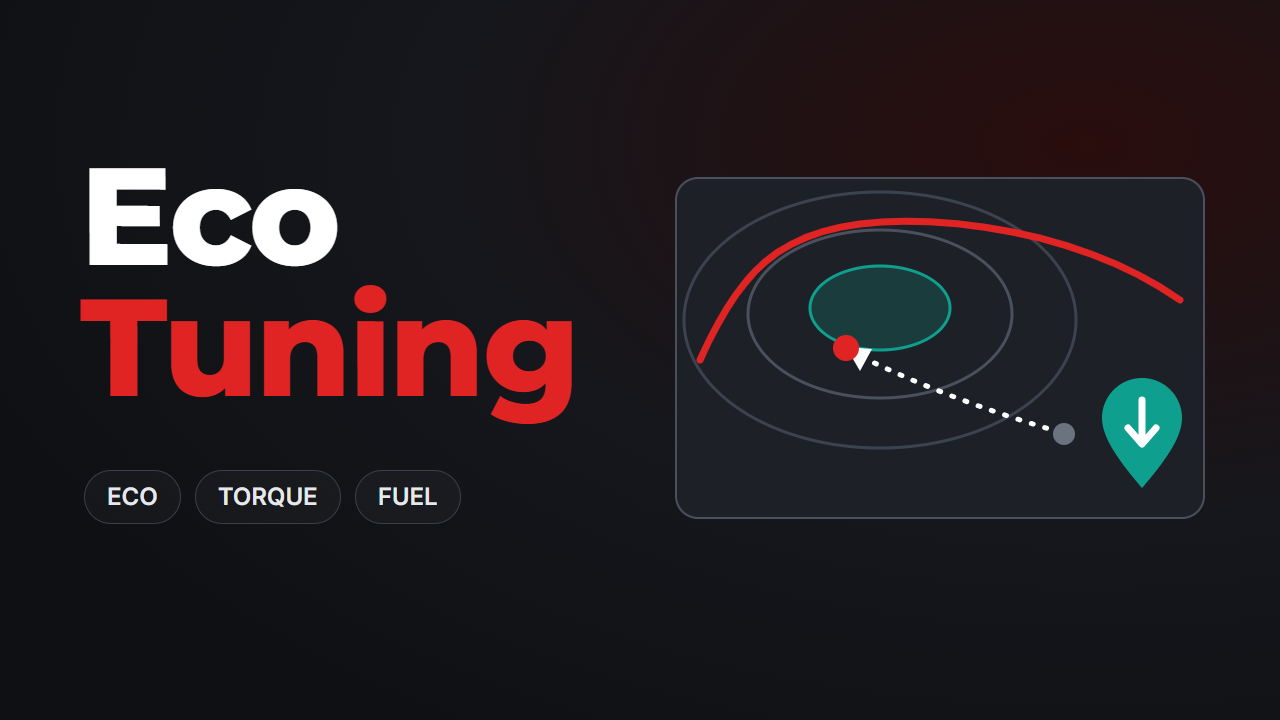
Eco Tuning is an ECU calibration for fuel economy: boost and torque are added at low and middle rpm so the car pulls comfortably one gear higher. In our database the option is mostly available for diesel ECUs: Bosch EDC and MD1, Continental SID, Delphi. For tuners: send the original file and get a ready-to-flash file with corrected checksums, on average in 30–60 minutes.
Why an engine is more economical at lower revs
The fuel an engine burns per unit of work is not constant. Plot it on a map of engine speed against load and you get islands. A diesel is most efficient at low to middle revs and high load, where good passenger-car diesels use about 200 g of fuel per kWh. At high revs and light load a noticeable share of the fuel goes into friction and pumping gas in and out, and the same kilowatt costs more.
The same power can be produced in different ways: one gear lower at high revs and light load, or one gear higher at low revs and higher load. In the second case the engine runs closer to its best island. At low revs, though, a stock diesel often lacks torque: the turbo has not spooled up, the smoke limiter holds fuel back, and the driver changes down. Eco tuning adds torque in exactly that zone.
What changes in the file
- Boost at low rpm: a higher target, reached earlier, so the turbo comes on sooner.
- Torque at low and middle rpm: the pedal map and torque limits in that range.
- Fuel for the extra air: fuel is added only as far as it can be burned without smoke in the air the boost provides.
Peak power is not the aim of this calibration, that is what Stage 1 is for. EGR, the particulate filter and AdBlue keep working unless they are disabled with separate options. Sensors and the ECU's logic stay as they are.
How much it really saves
Sellers of eco remaps usually promise 10–15%, sometimes up to 20%. Those are their own figures: ADAC, Germany's largest motoring club, says it has no reliable neutral studies of savings from eco tuning. The physics works in the file's favour on one condition only: the driver uses the extra torque to run at lower revs. Spend it on harder acceleration and the extra fuel eats the whole saving.
Cars that run at a steady pace have the best chance: motorway driving, long routes, commercial vehicles with regular drivers. On short urban trips the effect is usually smaller. The only way to check the result is on your own car:
The trip computer shows a calculated figure. For a before-and-after comparison, brim-to-brim fill-ups and odometer mileage are more reliable.
Who Eco suits and who it does not
Makes sense
- diesel fleet and commercial vehicles on regular routes
- plenty of motorway and steady driving
- a driver who does not need performance
- a healthy engine with no faults
Will not help
- short town trips from a cold start
- the goal is performance: then you need Stage 1
- consumption went up because of a fault: a clogged DPF, EGR, injectors with large corrections. That needs a repair
How Eco differs from Stage 1
Both calibrations work with the same torque and boost maps, but with different goals. Stage 1 raises power and torque across the rev range, while Eco adds torque where the engine spends most of its everyday driving. If the hardware has been modified, you are looking at Stage 2.
Extra torque low down loads the clutch and dual-mass flywheel like any tune, so check them before flashing. On an automatic, the gearbox control unit chooses the gears and the engine file does not change its strategy: the saving depends on how the gearbox uses the extra torque.
How to order the file
- Read the original file via OBD or on the bench with the tool you use, and keep a copy.
- Upload it to the portal and select ECO TUNING. In the comment, state the gearbox and how the car is mostly driven: motorway, town, loaded.
- Get the finished file with recalculated checksums, on average within 30–60 minutes.
- Flash the file, clear the faults and compare consumption over several fill-ups.
If your ECU is not in the list below or in our ECU database, send the file with a request: we will check the software and tell you whether Eco is possible.
Already have the file? Upload it to the portal and select ECO TUNING, the finished file arrives on average in 30–60 minutes.
Order Eco TuningSupported ECUs for the ECO TUNING service
- Bosch EDC16C4
- Bosch EDC16CP34
- Bosch EDC16U1
- Bosch EDC16U31
- Bosch EDC16U34
- Bosch EDC17C46
- Bosch EDC17C54
- Bosch EDC17C64
- Bosch EDC17C74
- Bosch EDC17CP04
- Bosch EDC17CP14
- Bosch EDC17CP20
- Bosch EDC17CP24
- Bosch EDC17CP44
- Bosch EDC17CP54
- Bosch EDC17CP74
- Bosch MD1
- Bosch MD1CP004
- Bosch MD1CP014
- Bosch MD1CS004
- Bosch MD1CS014
- Delphi DCM6.2V
- Siemens/Continental PCR2.1
- Siemens/Continental PPD1.x
- Bosch EDC16C0
- Bosch EDC16C08
- Bosch EDC16C34
- Bosch EDC16C39
- Bosch EDC16CP39
- Bosch EDC17C10
- Bosch EDC17C60
- Bosch EDC17CP11
- Bosch EDC17CP42
- Bosch EDC17CP52
- Bosch MD1CS003
- Delphi DCM3.4(+)
- Delphi DCM3.5
- Delphi DCM6.2A
- Delphi DCM6.2C
- Delphi DCM7.1A
- Delphi DCM7.1B
- Marelli MJD8
- Marelli MJD8F2
- Marelli MJD8F3
- Marelli MJD9
- Marelli MJD9DF
- Siemens/Continental SID201
- Siemens/Continental SID208
- Siemens/Continental SID801
- Siemens/Continental SID803
- Siemens/Continental SID803A
- Siemens/Continental SID804
- Siemens/Continental SID806
- Siemens/Continental SID807
- Siemens/Continental SID807EVO
- Bosch EDC16C08
- Bosch EDC16C34
- Bosch EDC16C39
- Bosch EDC16C39 (CAN)
- Bosch EDC16C39 (K-Line)
- Bosch EDC16C8
- Bosch EDC16CP39
- Bosch EDC17C10
- Bosch EDC17C49
- Bosch EDC17C69
- Bosch EDC17C79
- Bosch EDC17C84
- Bosch EDC17CP52
- Bosch MD1CS003
- Bosch MD1CS006
- Delphi DCM3.4(+)
- Delphi DCM3.5
- Delphi DCM7.1A
- Marelli MJD6
- Marelli MJD8
- Marelli MJD8F2
- Marelli MJD8F3
- Marelli MJD9DF
- Siemens/Continental SID803
- Siemens/Continental SID803A
- Bosch EDC16C3
- Bosch EDC16C34
- Bosch EDC16C7
- Bosch EDC16CP39
- Bosch EDC16U31
- Bosch EDC17C10
- Bosch EDC17C70
- Bosch EDC17CP42
- Bosch MD1CS004
- Bosch MD1CS005
- Delphi DCM3.5
- Delphi DCM6.1
- Delphi DCM7.1
- Marelli MFD6F3
- Marelli MJD8F2
- Siemens/Continental SID202
- Siemens/Continental SID206
- Siemens/Continental SID208
- Siemens/Continental SID209
- Siemens/Continental SID209 - FRV
- Siemens/Continental SID209recovery
- Siemens/Continental SID211
- Siemens/Continental SID802
- Siemens/Continental SID807EVO
- Bosch EDC16C2
- Bosch EDC16C32
- Bosch EDC16CP31
- Bosch EDC16CP36
- Bosch EDC17C42
- Bosch EDC17C43
- Bosch EDC17C66
- Bosch EDC17C84
- Bosch EDC17CP01
- Bosch EDC17CP10
- Bosch EDC17CP46
- Bosch EDC17CP57
- Bosch EDC17CP60
- Bosch EDC17CP66
- Bosch MD1CP001
- Bosch MD1CS006
- Delphi CRD.11
- Delphi CRD2
- Delphi CRD3
- Delphi CRD3.10
- Delphi CRD3.1R
- Delphi CRD3.20
- Delphi CRD3.2R
- Delphi CRD3.30
- Delphi CRD3.40
- Delphi CRD3.50
- Delphi CRD3.58
- Delphi CRD3.59
- Delphi CRD3.60
- Delphi CRD3.7A
- Delphi CRD3.E1
- Delphi CRD3.F1
- Delphi CRD3.N5
- Delphi CRD3P.A0
- Delphi CRD3P.B0
- Delphi CRD3P.C0
- Delphi CRD3P.D1
- Delphi CRD3P.E1
- Delphi CRD3P.G0
- Siemens/Continental SID307
- Siemens/Continental SID310
- Bosch EDC16C3
- Bosch EDC16C36
- Bosch EDC16C41
- Bosch EDC16CP33
- Bosch EDC16CP42
- Bosch EDC17C11
- Bosch EDC17C42
- Bosch EDC17C84
- Bosch MD1CS006
- Bosch MD1CS016
- Delphi DCM3.4
- Siemens/Continental SID301
- Siemens/Continental SID303
- Siemens/Continental SID304
- Siemens/Continental SID305
- Siemens/Continental SID305/6
- Siemens/Continental SID306
- Siemens/Continental SID307
- Siemens/Continental SID309
- Siemens/Continental SID310
- Siemens/Continental SID321
- Siemens/Continental SID809
- Bosch EDC16C3
- Bosch EDC16C36
- Bosch EDC16C39
- Bosch EDC16C9
- Bosch EDC16CP33
- Bosch EDC17C10
- Bosch EDC17C11
- Bosch EDC17C18
- Bosch EDC17C19
- Bosch EDC17C42
- Bosch EDC17C59
- Bosch EDC17C60
- Bosch EDC17C69
- Bosch EDC17C84
- Bosch EDC17CP47
- Bosch MD1CS003
- Delco E98
- Delphi DCM3.7AP
- Delphi DCM6.2A
- Delphi DCM7.1A
- Delphi DCM7.1B
- Marelli MJD6
- Marelli MJD8F3
- Marelli MJD9DF
- Siemens/Continental SID309
- Siemens/Continental SID310
- Siemens/Continental SID321
- Siemens/Continental SID809
- Bosch EDC16C08
- Bosch EDC16C34
- Bosch EDC16CP39
- Bosch EDC17C10
- Bosch EDC17C60
- Bosch EDC17CP11
- Bosch EDC17CP42
- Bosch EDC17CP52
- Bosch MD1CS003
- Delphi DCM3.4(+)
- Delphi DCM3.5
- Delphi DCM6.2A
- Delphi DCM6.2C
- Delphi DCM7.1A
- Delphi DCM7.1B
- Marelli MJD8
- Marelli MJD8F2
- Marelli MJD8F3
- Marelli MJD9DF
- Siemens/Continental SID201
- Siemens/Continental SID208
- Siemens/Continental SID801
- Siemens/Continental SID803
- Siemens/Continental SID803A
- Siemens/Continental SID804
- Siemens/Continental SID806
- Siemens/Continental SID807
- Siemens/Continental SID807EVO
- Bosch EDC16C3
- Bosch EDC16C36
- Bosch EDC16C41
- Bosch EDC16CP33
- Bosch EDC17C11
- Bosch EDC17C42
- Bosch EDC17C84
- Bosch MD1CS006
- Bosch MD1CS016
- Delphi DCM3.4
- Siemens/Continental SID301
- Siemens/Continental SID303
- Siemens/Continental SID305
- Siemens/Continental SID305/6
- Siemens/Continental SID306
- Siemens/Continental SID307
- Siemens/Continental SID309
- Siemens/Continental SID310
- Siemens/Continental SID321
- Siemens/Continental SID809
- Bosch EDC16CP34
- Bosch EDC16U1
- Bosch EDC16U31
- Bosch EDC16U34
- Bosch EDC17C46
- Bosch EDC17C54
- Bosch EDC17C64
- Bosch EDC17C74
- Bosch EDC17CP04
- Bosch EDC17CP14
- Bosch EDC17CP20
- Bosch EDC17CP24
- Bosch EDC17CP44
- Bosch EDC17CP74
- Bosch MD1CP004
- Bosch MD1CS004
- Delphi DCM6.2V
- Siemens/Continental PCR2.1
- Siemens/Continental PPD1.x
Frequently asked questions
How much fuel does Eco Tuning save?
Sellers of eco remaps promise 10–15%, sometimes up to 20%, but according to ADAC there are no neutral studies. The result depends on driving style and route, so check it with fill-ups before and after.
Will the car get slower?
There is more torque at low and middle rpm, so in everyday driving the car pulls more confidently. Peak power is not the aim of Eco, that is what Stage 1 is for.
How is Eco different from Stage 1?
Both calibrations change the torque and boost maps, but Stage 1 raises power across the rev range, while Eco adds torque low down so the car can run at lower revs.
Which vehicles is Eco worth it for?
Mainly diesel fleet and commercial vehicles on regular routes at a steady pace. On short town trips the effect is smaller.
Does Eco work with an automatic gearbox?
Yes, but on an automatic the gearbox control unit chooses the gears, and the engine file does not change its strategy. The saving depends on how the gearbox uses the extra torque.
How do I compare consumption before and after?
Over 2–3 full tanks before and after flashing, on the same route with the same driver: litres from receipts, distance from the odometer. The trip computer shows a calculated figure.
Does Eco disable the DPF or EGR?
No, the emissions equipment keeps working. If it needs to be disabled, those are separate options in the same order.
Can the stock software be restored?
Yes, if the original file was saved: just flash it back. That is why the original should always be kept.
My ECU is not in the list. What now?
Send the file with a request: we will check the software and tell you whether Eco can be done on that ECU.