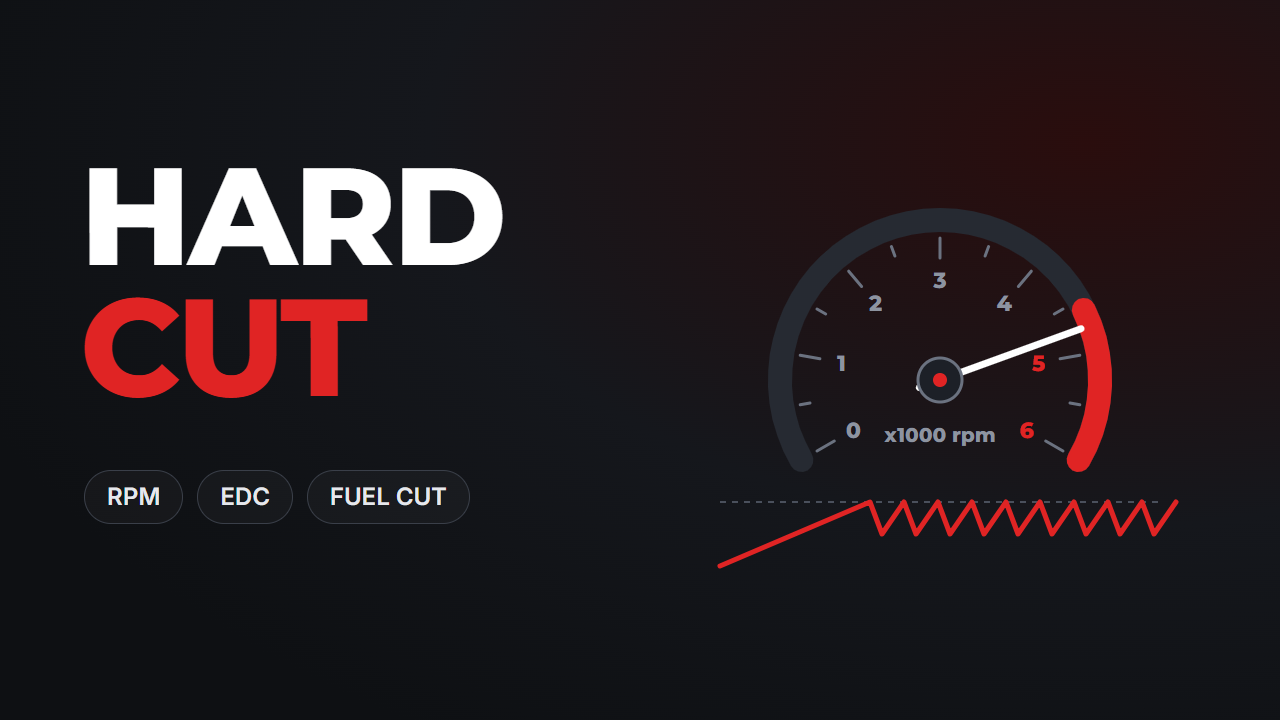
Hard Cut Limit changes how the rev limiter behaves. Instead of easing fuel off as the engine approaches the limit, the ECU keeps full fuelling right up to the mark, then cuts fuel sharply and brings it straight back, so the engine bounces off the limiter with that familiar staccato sound. The rev limit and power stay stock. The option is mainly for Bosch EDC15, EDC16 and EDC17 diesel ECUs. For tuners: send us the original file and get a ready-to-flash file with corrected checksums, on average in 30–60 minutes.
Soft limiter vs hard cut
Every limiter holds revs the same way: it reduces the energy the engine gets. The difference is how abruptly. A soft limiter starts trimming fuel or ignition timing on the way to the limit, so revs settle against it smoothly, without jolts. A hard limiter does nothing until the mark itself and then shuts fuel off completely: revs dip, fuel returns, revs climb again.
That is where the bounce comes from: the engine reaches the limit again and again and drops back by the width of the hysteresis. Production systems usually have both stages. In Saab's factory documentation for the Bosch Motronic ME9 on the 2.8T V6, for example, the engine is protected by a torque limit at maximum engine speed, with a fuel cut above 6600 rpm as the last line of defence. A Ford calibration on Bosch MG1 spells it out directly: a hard limit, and a soft limit derived from it by an offset.
How a diesel holds its revs
A modern diesel does have a throttle valve, but it does not control power. Power is set by injection quantity alone, and there is no spark to cut. In Bosch EDC units the driver's request is turned into torque, limited by tables over engine speed, converted into milligrams of fuel per stroke and limited again: by smoke, temperatures and other conditions. So on a diesel the rev limiter is always a fuel limiter.
In a stock calibration fuelling usually tapers off gradually near maximum revs, and the engine meets the limit softly. Hard Cut turns that taper into a cliff: full fuel right up to the limit, then zero and back again. The option on our list is almost entirely diesel: of 97 ECUs, 82 are Bosch EDC, and most of the rest are Siemens/Continental SID, Delphi and PPD.
On petrol engines a hard cut is done with fuel or with ignition. An ignition cut sounds harsher, but the unburnt fuel goes into the exhaust and heats the catalytic converter, which is why production cars more often cut fuel.
What changes in the file
| Parameter | Stock | After Hard Cut |
|---|---|---|
| Rev limit | stock | stock |
| How revs approach the limit | smoothly, fuel eased off early | full fuel up to the limit, then cut |
| Power and torque below the limit | stock | stock |
| Protection for temperature, oil pressure and faults | active | active |
The rest of the calibration is unchanged, checksums are recalculated and the file is ready to flash. Hard Cut can go into the same file as Stage 1 and other options.
Why people fit a hard cut and what it will not do
What it gives
- A sharp, motorsport-style sound and bounce at the limiter.
- You hear and feel the limit clearly; it is hard to miss.
What it does not give
- Power or torque: below the limit the calibration is stock.
- Higher revs: the limit stays where it was.
- Faster acceleration: at the limiter the car does not gain speed, soft or hard.
Do not confuse Hard Cut with Pop & Bangs: those exhaust pops happen when you lift off the throttle, while Hard Cut only acts at the limiter. And if the car has a separate rev limit at standstill in neutral, Hard Cut does not remove it; it only changes how the engine behaves at the limit. The standstill limit is lifted by a separate option, Rev Limiter Deactivation.
What it does to the car
Every cut and restart of fuelling is a torque jolt that travels through the flywheel, the clutch or torque converter, the shafts and the engine mounts. A couple of seconds on the limiter will not break anything, but holding the engine there for long, especially under load, is a bad idea. If the dual-mass flywheel or the mounts are already tired, a hard cut will only speed up their wear.
How to order
- Read the original file via OBD or on the bench with the tool you use. We need an unmodified stock file.
- Upload it to the portal and select HARD CUT LIMIT. You can add Stage 1 and other options at the same time.
- Get the finished file with recalculated checksums, on average within 30–60 minutes.
- Flash the file and test the limiter with the engine warm, on a closed course.
Your ECU is not in the list below? Send the file with a request and we will check whether there is a solution for it.
A hard cut loads the driveline and engine mounts more than the stock limiter, and frequent or long spells on it speed up wear. A loud engine bouncing off the limiter on public roads may breach noise rules. Use the option where the rules allow it: on a track, a closed course or in motorsport. Responsibility for using the file lies with the vehicle owner.
Already have the file? Upload it to the portal and select HARD CUT LIMIT, the finished file arrives on average in 30–60 minutes.
Order Hard Cut LimitSupported ECUs for the HARD CUT LIMIT service
Frequently asked questions
Does Hard Cut add power or revs?
No. The rev limit, power and torque stay stock; only the way the engine behaves at the limit changes.
Then why fit a hard cut?
For the sound and feel: the engine bounces off the limiter like a motorsport car, and you can clearly hear the limit.
Will the exhaust pop and bang?
Hard Cut gives a staccato sound at the limiter. Exhaust pops when lifting off the throttle are a separate option, Pop & Bangs.
Is it bad for the engine and driveline?
Every fuel cut is a torque jolt through the flywheel, clutch and mounts. Brief touches of the limiter will not break anything, but do not hold the engine there for long.
Which ECUs is Hard Cut available for?
Mostly Bosch EDC15, EDC16 and EDC17 diesels, plus Siemens/Continental SID, Delphi and PPD. If your ECU is not in the list, send the file with a request.
Will it work at standstill in neutral?
If the car has a separate rev limit at standstill, Hard Cut does not remove it: it only changes how the engine behaves at the limit.
Can the stock limiter be restored?
Yes, just flash the saved original file.
Can Hard Cut be combined with Stage 1?
Yes, everything is done in one file and one order.