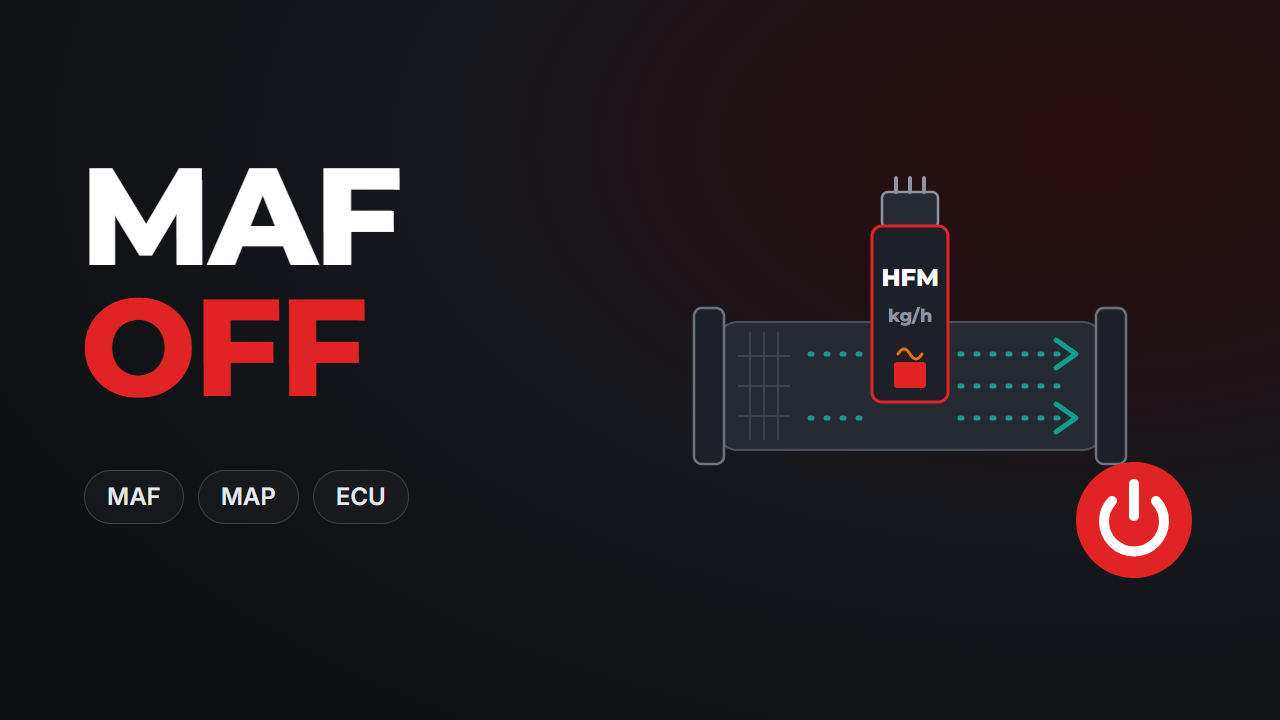
MAF Off disables the mass air flow sensor (MAF) in the ECU software. The ECU stops monitoring the sensor and stops taking air mass from it. From then on it works out the air from manifold pressure, engine speed and temperature, or from substitute values, depending on the ECU. MAF faults P0100 to P0104 and the MAF-related limp mode go away. The option is mostly used on diesels. For tuners: send us the original file and get a ready-to-flash file with corrected checksums, on average in 30–60 minutes.
What the ECU uses the MAF signal for
The MAF sits in the intake right after the air filter. In a current Bosch sensor the airflow passes over a heated membrane, and the sensor works out the air mass from the temperature difference across it. A new sensor is accurate to ±1.5 %. The intake air temperature sensor often lives in the same housing.
On a petrol engine the air mass is the basis of the mixture. Saab's factory documentation for the Bosch Motronic ME9 lays the chain out plainly:
A diesel always runs lean, so it needs the sensor for other jobs. VW's description of the 1.9 TDI with unit injectors says the MAF signal is used to calculate the injection quantity and the exhaust gas recirculation rate. In practice that means three things:
- Smoke limit. In Bosch EDC ECUs the smoke map is built on air mass: it stops the ECU injecting more fuel than can burn without visible smoke.
- EGR valve. The ECU sets how much fresh air should reach the cylinders and opens the EGR valve until the MAF reads that figure. Without measured air there is nothing to control recirculation with.
- Particulate filter. On VW's 3.0 V6 TDI one of the two DPF soot models works out filter flow resistance from exhaust pressure, exhaust temperature and the MAF.
How an engine works out air without a MAF
Air mass can be calculated instead of measured. Given manifold pressure and temperature, engine speed and displacement, only one unknown is left: volumetric efficiency, the share of the cylinder the engine actually fills at that speed and pressure. It comes from a table in the calibration. The method is called speed density.
Production engines work this way too. The VW 2.0 FSI and the twin-charged 1.4 TSI (both on Bosch MED 9.5.10) have no MAF at all: the ECU calculates air from the manifold pressure and temperature sensors and engine speed. The weak spot is that the VE table only holds for the engine it was written for. Change the camshaft, the heads or the intake and the table has to be rewritten, whereas a MAF picks up those changes by itself.
When the sensor fails, the factory software also falls back on a backup calculation, but a crude one. On the 1.9 TDI a fixed substitute value replaces the signal; petrol ECUs in limp mode estimate air from engine speed, throttle angle and temperature. The car drives, but with a warning light and often with reduced power. MAF Off turns the backup path into the main one and sets it up for normal driving instead of limp mode.
When to disable the MAF and when to replace it
A P0101 (range/performance) code often does not mean a bad sensor. An air leak, a boost hose that has come off, an EGR valve that will not close, and the MAF sees a different amount of air from what the ECU expects. Disable the sensor and you hide the symptom while the cause stays. So check the intake first and compare specified and actual air mass in the logs.
MAF Off makes sense
- A diesel where the MAF mainly serves the EGR system, and the EGR is already off.
- The sensor has been removed or there is nothing to replace it with.
- A heavily modified intake: a different pipe diameter, a relocated sensor, a turbo that maxes out the MAF scale.
- Motorsport and off-road builds tuned from logs.
Better replace the sensor
- A road car with a healthy intake: a new sensor fixes the problem with no compromise.
- A diesel with working EGR and DPF: the sensor is part of how they work.
- A naturally aspirated petrol engine without a manifold pressure sensor: only a crude throttle-based estimate would be left.
- The fault comes from an intake leak, not from the sensor.
Some people fit a diode or resistor in the MAF plug instead, so the ECU sees a constant signal. On older EDC15 diesels this kept the smoke limit wide open. Owners who tried it report black smoke under hard acceleration, and on some cars the ECU went into limp mode and lost power. Newer ECUs check the MAF signal against their own calculation and log a fault when the two disagree.
What changes in the software
| Function | Stock | After MAF Off |
|---|---|---|
MAF monitoring, faults P0100–P0104 | active | off |
| Where air mass comes from | MAF | calculated from pressure, engine speed and temperature, or substitute values |
| Smoke limit (diesel) | based on measured air | based on calculated air |
| Air-mass-based EGR control (diesel) | active | not possible without a MAF |
| Boost, temperature and fuel pressure protection | active | active |
The rest of the calibration stays as it was and checksums are corrected. On a diesel MAF Off usually goes into the same file as EGR Off. If a particulate filter is fitted, tell us whether it stays: on some ECUs the soot model uses the MAF, and the solution depends on it (see DPF Off). On a petrol engine small errors in the calculation are trimmed out by closed-loop lambda control, so the upstream O2 sensor has to be healthy.
Which fault codes go away
MAF codes per SAE J2012. Manufacturers also have their own codes for the same faults.
| Code | Meaning |
|---|---|
P0100 | Mass or volume air flow circuit malfunction |
P0101 | Mass or volume air flow circuit range/performance |
P0102 | Mass or volume air flow circuit low input |
P0103 | Mass or volume air flow circuit high input |
P0104 | Mass or volume air flow circuit intermittent |
What to do with the sensor and the intake
- The plug. On some ECUs the sensor can stay connected after flashing, on others the MAF plug has to be disconnected. We will tell you for your ECU.
- Intake air temperature. If the temperature sensor is built into the MAF housing, you cannot just throw the MAF away: the ECU still needs that temperature.
- The intake. Find and fix leaks before flashing. Without the MAF the ECU loses one of its ways of noticing an air problem.
- After flashing clear the faults and check boost (specified and actual) and smoke at full load in the logs, and on a petrol engine the fuel trims.
How to order
- Read the original file over OBD or on the bench with the tool you use. It has to be unmodified stock.
- Upload the file to the portal and choose MAF OFF. In the comment say why the sensor is being disabled: faulty, removed, modified intake. On a diesel, tick EGR and DPF too if they are being disabled.
- Get the finished file with corrected checksums, on average in 30–60 minutes.
- Flash the file, clear the faults and check the car on the road with logs.
Send the file with a request and we will check whether there is a solution for your ECU.
On a diesel, disabling the MAF takes away air-mass-based EGR control and an accurate smoke limit, which affects NOx and soot emissions. In the EU, the UK, the US and a number of other countries, changes to emission-related systems are not allowed on public roads and may cause a failed roadworthiness test. The service is intended for tuners and is used where the law allows it: motorsport, off-road, export and vehicles not used on public roads. Responsibility for using the file lies with the vehicle owner.
Already have the file? Upload it to the portal and choose MAF OFF, the finished file arrives on average in 30–60 minutes.
Order MAF OffFrequently asked questions
Can the car be driven without a MAF after MAF Off?
Yes: the ECU calculates air from manifold pressure, engine speed and temperature, or uses substitute values. It is a compromise, though: measured air is more accurate than calculated air, especially if the intake or camshaft is changed later.
Why is software better than a diode or resistor in the MAF plug?
A constant signal fools the ECU: the smoke limit stays wide open, hence the black smoke, and newer ECUs recognise such a signal and log a fault. In the software the ECU switches to calculated air and stops monitoring the sensor.
Do I need MAF Off if the EGR is already disabled?
Not if the sensor works. On older diesels the MAF mainly serves the EGR system, on newer ones it also feeds the smoke limit and the DPF soot model, so it depends on the ECU.
Will power or fuel consumption change?
Power and economy are not what this option is for: only the source of air data changes, the rest of the calibration stays stock. If the engine smokes or drives worse afterwards, look for an intake leak and check the logs.
Do I have to remove the sensor?
On some ECUs the sensor can stay, on others the plug has to be disconnected. If the intake air temperature sensor is built into the MAF housing, the ECU still needs it. We will advise for your ECU.
Can the MAF be disabled on a petrol engine?
Yes, where the ECU can calculate air from manifold pressure, usually on turbocharged engines. On a naturally aspirated engine without a pressure sensor only a crude throttle-based estimate is left, and we do not recommend it.
Which fault codes go away?
MAF faults P0100 to P0104 and the limp mode tied to them. Faults from other sensors and systems remain.
Can it be returned to stock?
Yes: flash the saved original file and fit a working sensor.
Is there a solution for my ECU?
Send the file with a request: we will check the software and tell you whether the MAF can be disabled on that ECU.