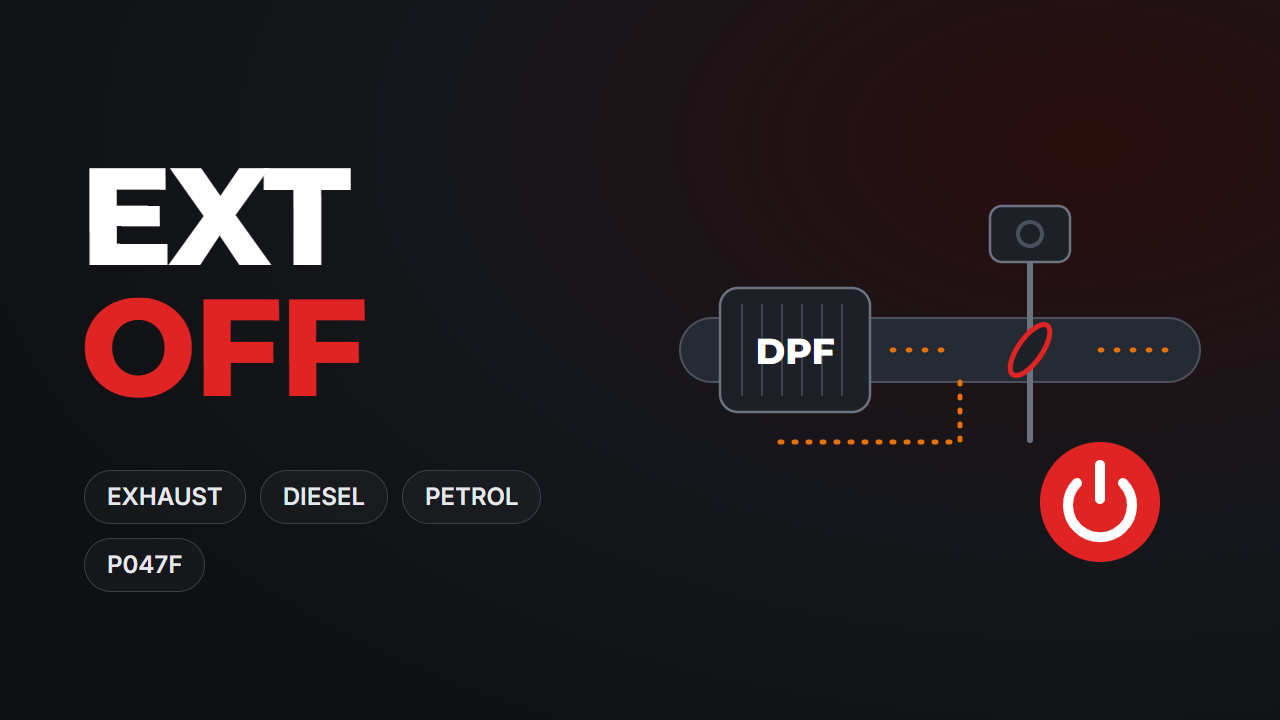
EXT Flaps Off disables control and diagnostics of the exhaust flap in the ECU software. It is meant for a flap that has failed or been removed: the ECU stops commanding and checking it, and the faults and limp mode it causes go away. The option exists for both diesel and petrol cars. For tuners: send us the original file and get a ready-to-flash file with corrected checksums, on average in 30–60 minutes.
Why a diesel has a flap in the exhaust
On a diesel the flap sits in the exhaust after the particulate filter. When it closes partway, it raises the pressure and temperature of the gas ahead of it, and the ECU uses that in three situations:
- Low-pressure EGR. This loop takes gas after the particulate filter and returns it to the intake ahead of the turbo. Pressure there is low, so a further flap is fitted behind the filter: closing it raises the exhaust pressure again (as described by IKA, an exhaust parts maker). Since Euro 6 this layout has become common.
- DPF regeneration. Gas trapped ahead of the partly closed flap is compressed and heats up, the DOC catalyst warms and soot burn-off begins. During a parked regeneration, a closed flap also keeps the heat in the filter.
- Cold warm-up. On a cold engine the flap is closed so the engine and exhaust warm up faster.
The last two points are described in International Engine and Isuzu patents on exhaust flap control during regeneration. What the flap does on a particular car is up to the manufacturer's calibration.
An example from VW service documents: on US-market 2.0 TDI cars (Jetta, Golf, Jetta SportWagen 2009–2012 with CBEA and CJAA engines, Passat 2012 with CKRA) the exhaust flaps failed. Water and road salt corrode the shaft, and the flap sticks open or closed. Along with the flap faults, the ECU also stores P0401: less gas than expected is flowing through the EGR.
The exhaust flap on a petrol car
On petrol cars the exhaust flap is most often a sound flap: it switches the gas between the silencer chambers and a straight pipe. It fails for the same reasons: it binds in the pipe or the actuator gives up. For Mercedes with the M254 and M256 petrol engines (2024–2025), for example, the manufacturer's instruction for "actuator does not open" faults is to check the flap's travel and, if it binds, replace the pipe section with the flap.
EXT Flaps Off or Exhaust Flaps Always Open Fix
These two options are often confused, but they do different jobs:
EXT Flaps Off
- the flap is faulty, stuck or removed
- the ECU stops controlling and checking it
- flap faults and limp mode go away
- diesel and petrol
Exhaust Flaps Always Open Fix
- the sound flap works
- the ECU keeps it open in every mode
- sports exhaust sound all the time
- details on the Exhaust Flaps Always Open Fix page
Flaps on the intake side are covered by other services: Flaps Off for swirl flaps and TVA Off for the diesel throttle.
Which fault codes go away
Exhaust flap codes differ between manufacturers. Examples from service documents and the SAE standard:
| Code | Meaning |
|---|---|
P047F / P048A | Exhaust pressure control valve "A" stuck open / stuck closed |
P0477 | Exhaust pressure control valve "A" circuit low |
P048B / P048C | Valve position sensor circuit / range and performance |
P0475 / P0476 | Exhaust pressure control valve "A" circuit / range and performance |
P13C273, P140473 (Mercedes) | Flap 1 or 2: the actuator does not open the flap |
The first three rows are the codes from the VW bulletin on the 2.0 TDI. For Renault, Nissan and Dacia diesels, our EXT Flaps Off set removes P0487–P0490 and the factory codes P1484–P149A.
What changes in the software
| Function | Stock | After EXT Flaps Off |
|---|---|---|
| Exhaust flap control | active | off |
| Position sensor and actuator circuit monitoring | active | off |
| Flap faults and limp mode caused by them | on a fault | do not appear |
| Injection, boost and the rest of the calibration | stock | unchanged |
On a diesel the ECU can no longer close the flap when it needs to. DPF regenerations may take longer, warm-up in freezing weather may be slower, and an active low-pressure EGR loop may get less gas than expected. When EGR Off and DPF Off go into the same file, some of those jobs disappear. If the systems stay, mention it in the order and we will advise for your ECU. Checksums are recalculated, so the file is ready to flash straight away.
What to do with the flap
- Make sure it is fully open. The ECU no longer controls it, and a partly closed flap in the exhaust is extra restriction that costs pulling power.
- Stuck partly closed: free the spindle or fix the flap open.
- Actuator or flap removed: after EXT Flaps Off the ECU no longer checks them. Make sure the exhaust is gas-tight where the part used to be.
How to order the file
- Read the original file via OBD or on the bench (bench, boot) with the tool you use. We need an unmodified stock file.
- Upload it to the portal and select EXT FLAPS OFF. Tell us what is wrong with the flap (faulty, stuck, removed) and what is on the car: EGR, DPF.
- Get the finished file with recalculated checksums, on average within 30–60 minutes.
- Flash the file, clear the faults and check that no new flap faults appear.
On a diesel the exhaust flap works for recirculation, DPF regeneration and warm-up, which means it helps reduce emissions. On a petrol car an open sound flap makes the exhaust louder. In a number of countries, changing emissions- or noise-related components on vehicles used on public roads is prohibited and may cause an inspection failure. Responsibility for using the file lies with the vehicle owner.
Already have the file? Upload it to the portal and select EXT FLAPS OFF, the finished file arrives on average in 30–60 minutes.
Order EXT Flaps OffSupported ECUs for the EXT FLAPS OFF service
- Bosch EDC17C42
- Bosch EDC17C43
- Bosch EDC17C66
- Bosch EDC17C84
- Bosch EDC17CP01
- Bosch EDC17CP10
- Bosch EDC17CP46
- Bosch EDC17CP57
- Bosch EDC17CP60
- Bosch EDC17CP66
- Bosch MD1CP001
- Bosch MD1CS006
- Delphi CRD3
- Delphi CRD3.10
- Delphi CRD3.1R
- Delphi CRD3.20
- Delphi CRD3.2R
- Delphi CRD3.30
- Delphi CRD3.40
- Delphi CRD3.50
- Delphi CRD3.58
- Delphi CRD3.59
- Delphi CRD3.60
- Delphi CRD3.7A
- Delphi CRD3.E1
- Delphi CRD3.F1
- Delphi CRD3.N5
- Delphi CRD3P.A0
- Delphi CRD3P.B0
- Delphi CRD3P.C0
- Delphi CRD3P.D1
- Delphi CRD3P.E1
- Delphi CRD3P.G0
- Siemens/Continental SID310
- Bosch EDC17C10
- Bosch EDC17C11
- Bosch EDC17C18
- Bosch EDC17C19
- Bosch EDC17C42
- Bosch EDC17C59
- Bosch EDC17C60
- Bosch EDC17C69
- Bosch EDC17C84
- Bosch EDC17CP47
- Bosch MD1CS003
- Delphi DCM6.2A
- Delphi DCM7.1A
- Delphi DCM7.1B
- Marelli MJD9DF
- Siemens/Continental SID309
- Siemens/Continental SID310
- Siemens/Continental SID321
- Siemens/Continental SID809
Frequently asked questions
How is EXT Flaps Off different from Exhaust Flaps Always Open Fix?
Always Open keeps a working sound flap open for the sound. EXT Flaps Off disables control and diagnostics of the flap when it is faulty or removed, on diesel and petrol cars.
Why does a diesel have a flap in the exhaust?
When it closes partway, it raises the pressure and temperature of the gas ahead of it. The ECU uses this for low-pressure EGR, DPF regeneration and cold warm-up.
Does my car have this flap?
Not every car does. Send the file and describe the car: the software shows whether the ECU controls an exhaust flap.
How does disabling it affect regeneration and warm-up?
The ECU can no longer close the flap, so regenerations may take longer and warm-up in freezing weather may be slower. If EGR Off and DPF Off go into the same file, some of those jobs disappear.
What position will the flap stay in?
The ECU no longer controls it. Make sure it is fully open, and if it is stuck partly closed, free the spindle or fix the flap open.
Can the flap or its actuator be removed?
Yes, after EXT Flaps Off the ECU no longer checks them. Make sure the exhaust is gas-tight where the part used to be.
Which fault codes go away?
Faults of the flap and its position sensor. On the VW 2.0 TDI, for example, these are P047F, P0477, P048A, P048B and P048C; on Mercedes M254 and M256 petrol engines, P13C273 and P140473.
Can EXT Flaps Off be combined with EGR Off, DPF Off and Stage 1?
Yes, everything is done in one file and one order.
How long does the file take?
On average 30–60 minutes.